On this page
An LNG carrier does not hold its cargo. It handles it — continuously, for the whole voyage — because no amount of insulation stops methane at −162°C from boiling.
This is a working guide to one vessel family: what it carries, how it is laid out, what it repeats every voyage, and who inspects it. It is groundwork rather than argument — read it and the articles about individual systems should land with somewhere to sit.
Everything the cargo touches is held away from people and fire. That one requirement shapes the hull, the voyage and the certificate.
Part I — What This Ship Is For
1. What it carries
Methane, as a liquid, at −162°C. That temperature is the price paid to move a substance that is a gas at ambient conditions at one six-hundredth of its volume.
Three consequences follow immediately from that one physical fact.
Cold. Ordinary hull steel fails in a brittle mode at this temperature. Whatever the cargo touches, and the structure around it, has to be different material — and something has to sit between cargo and hull.
Flammability. Methane mixed with air has a combustion range. A leak goes directly to fire and explosion.
Vaporisation. This is the decisive one. No amount of insulation reduces heat ingress to zero. Heat arrives, and the liquid boils TYPICAL. This ship's cargo is turning itself into gas for the entire voyage.
Carry methane as a liquid
        |
        +--> needs -162 C      --> hull steel cannot hold the cargo
        |                          --> separate containment + insulation
        |
        +--> flammable         --> leak detection and isolation become standing functions
        |
        +--> heat ingress is unavoidable --> the cargo keeps boiling
                                             --> the gas produced must keep being
                                                 disposed of
That last branch separates this ship from every other cargo carrier. It is not a ship that holds cargo. It is a ship that continuously handles boiling cargo. That one sentence explains everything below.
2. What those properties demand
Translated from physical properties into functions, there are four. No equipment names yet.
Containment, and a way to keep confirming it is intact. Hold a cryogenic liquid, but so that a leak in the first barrier is not immediately catastrophic. That requires barriers in layers — and a means of continuously observing the space between them. Learning after the voyage that something was leaking is learning too late.
Continuous disposal of the gas produced. Boil-off cannot accumulate in the tank; pressure rises. It has to go somewhere, and that disposal has to be part of normal operation rather than an emergency measure.
Legally meaningful measurement of the quantity transferred. This cargo's volume moves with temperature and pressure. How much was delivered is the subject of contracts and taxation, so measurement itself acquires legal standing.
Segregation. A flammable cargo has to be kept away from people and from ignition sources. That requirement shapes the ship, as the next section shows.
Part II — How the Ship Is Built
3. General arrangement
An LNG carrier's layout reads as one principle: everything the cargo touches is held away from people and fire.
[FWD]                                                              [AFT]
 +-------------------------------------------------------+---------------+
 |          CARGO AREA (tanks 1 ... N)                   |cofferdam| ER  |
 |                                                       |         |acc. |
 |   each tank: wrapped by the double hull,              |         |     |
 |              pump tower: Moss centre / membrane aft,  |         |     |
 |              dome on top -- piping exits here         |         |     |
 |   between tanks: cofferdams                           |         |     |
 |   double bottom and sides: ballast tanks              |         |     |
 +-------------------------------------------------------+---------------+
                                    cargo machinery room --^
                                    (compressors, heaters, vaporizers)
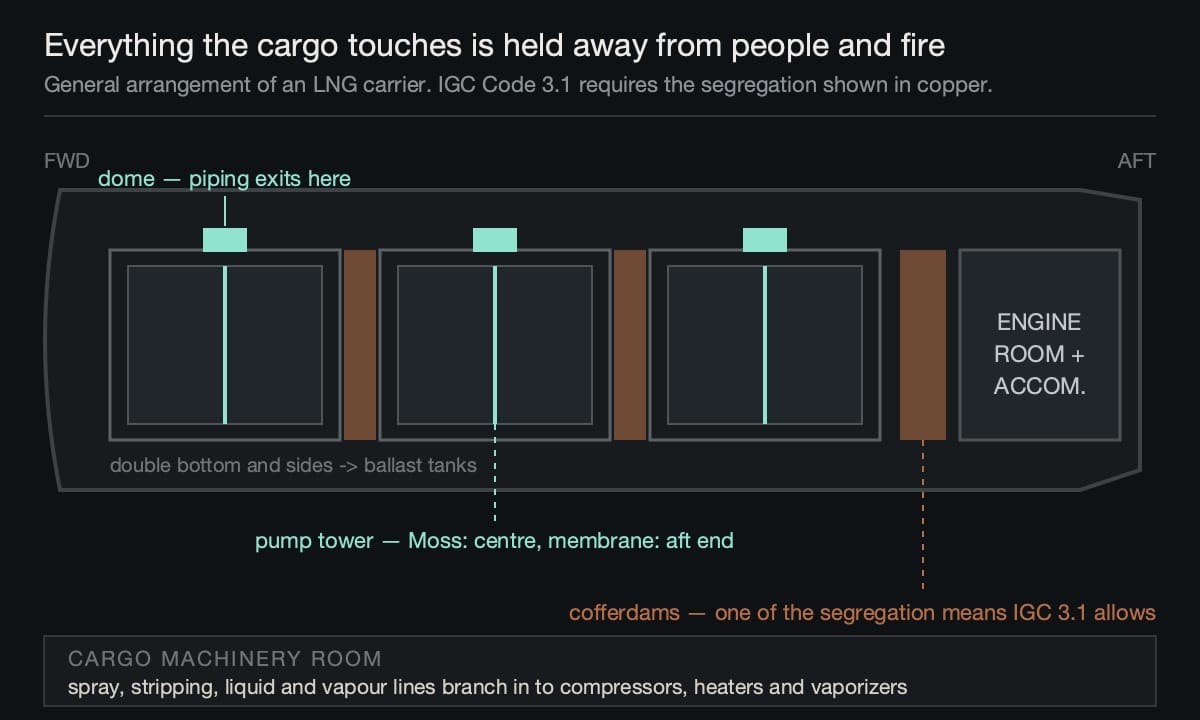
Cargo tanks run forward and aft of midships; machinery spaces and accommodation are gathered at the stern TYPICAL. That separation is not a convention — IGC Code 3.1.1 requires hold spaces to be segregated from machinery and boiler spaces, accommodation spaces, service spaces, control stations, chain lockers, domestic water tanks and stores, and to be located forward of machinery spaces of category A VERIFIED. Which barriers are acceptable depends on the containment system. Where no complete or partial secondary barrier is required, a cofferdam, an oil fuel tank or a single gastight all-welded bulkhead forming an “A-60” class division will serve (IGC 3.1.2). Where one is required — the LNG case — segregation from a space holding an ignition source or fire hazard must be by cofferdam or oil fuel tank, and a gastight “A-0” division is accepted only where the adjoining space has neither (IGC 3.1.3) VERIFIED. A cofferdam is the usual arrangement on this family, not the only one the Code allows; and an oil fuel tank is one of the permitted barriers rather than a space that has to be segregated from the cargo. The Code also admits alternative arrangements, including machinery spaces forward, on a risk basis.
A double hull wraps the tanks and their insulation. The double bottom and side spaces are used for ballast, and the ends between tanks become cofferdams. Where the containment system needs a complete or partial secondary barrier — the case for the membrane and Type B tanks LNG carriers use — IGC 3.1.6 requires a double bottom below −10°C and, below −55°C, a longitudinal bulkhead forming side tanks VERIFIED. Cofferdams between one cargo hold and the next are standard practice on this family rather than a requirement of that clause TYPICAL.
A pump tower carries the cargo piping down into each tank — but not in the same place on every ship. In a Moss spherical tank the tower stands at the centre of the sphere; in a membrane tank it hangs from the tank top at the aft end of the tank TYPICAL. Either way the submerged cargo pumps' piping runs up that tower and leaves through the dome at the top of the tank — a way of getting cargo out without penetrating the tank walls. Read “central pipe column” in older material as a description of the spherical ships specifically.
Into the cargo machinery room branch the spray and stripping lines, the liquid main and the vapour main, connecting there to the compressors, heaters and vaporizers TYPICAL.
4. The main system groups
Grouped by what they do, this ship's equipment falls into six clusters.
| Group | Systems on this family | What it does |
|---|---|---|
| Holding it | Cargo containment (membrane, independent Type A/B/C); containment integrity monitoring | Keeps the cryogenic liquid, and keeps watching the space between barriers |
| Moving it | Deepwell and submerged cargo pumps; emergency cargo pump; liquid and vapour mains | Makes cargo flow between tank and shore |
| Handling the boil-off | Cargo compressors (HD/LD); BOG-to-fuel; reliquefaction; gas combustion unit; fuel gas supply | Burns, returns or disposes of the gas that formed |
| Making the condition | Spray pumps and cooldown line; N₂ generator and fuel-installation nitrogen; vaporizers and heaters | Brings the tank to a state that can receive cargo, and holds it there |
| Protecting it | Cargo ESD; ship–shore ESD link; water spray and deluge; dry powder; cargo machinery room ventilation; venting and mast risers | Stops, isolates and vents when something goes wrong |
| Measuring it | Custody transfer measurement (CTMS); cargo tank instrumentation (CTS) | Establishes, legally, how much was delivered |
The third cluster is this family's identity. There are three ways to deal with the boiling gas and each is a separate system, which gives the ship a whole layer that other cargo carriers simply do not have.
What do you do with the gas that boiled off?
        |
        +--[1]--> burn it as fuel      --> fuel gas supply
        |                                  (this is where dual-fuel propulsion exists)
        |
        +--[2]--> reliquefy and return --> reliquefaction plant
        |                                  (nitrogen refrigerant)
        |
        +--[3]--> simply burn it off    --> gas combustion unit
                                           (the surplus engines and boilers cannot take)
Branch 1 matters most. The moment the cargo becomes the fuel, cargo design and propulsion selection stop being separable. The workbook's design remark says it in one line — "fuel-cargo integration makes propulsion selection and cargo design one decision."
5. What this ship does not have
Absence explains a ship as well as presence does. What is typically thin or absent on this family is deck cargo gear and hatch systems TYPICAL.
The reason is a property of the cargo. A ship whose cargo flows through pipes needs nothing to lift cargo with. No cranes, no hatch covers, no ramps. The hatch cover that makes a bulk carrier a bulk carrier never appears here.
Put the other way round: the deck is not empty, it is that everything is below it. Piping, domes and vent masts occupy the space instead.
Part III — What This Ship Repeats
6. The voyage cycle
A list of systems does not explain why a particular piece of equipment exists on its own. The voyage cycle does.
One cycle on an LNG carrier runs like this TYPICAL.
| Stage | What happens | Systems in play |
|---|---|---|
| After drydock | Humid air in the insulation space is replaced with nitrogen using vacuum pumps, until O₂ is below 2% and the dew point reaches −25°C | Nitrogen plant |
| Drying | Dry air removes moisture from tanks and piping — preventing ice during cooling and protecting cargo quality | Dry air, nitrogen |
| Inerting | Inert gas creates a non-explosive atmosphere, from an IG generator or from nitrogen | N₂ generator / IG |
| Gassing up | LNG vapour displaces the inert gas, which is vented. Typically taken as complete when CH₄ exceeds about 88% in each tank, the exact figure set by the operator's procedures | Vaporizers, vapour main, venting |
| Cooling down | LNG is sprayed through the spray header and cooldown grids at the top of each tank; the liquid vaporises at the sprays and cold vapour enters the tank, bringing steel and insulation down gradually. Temperature gradients are watched to avoid thermal shock | Spray pumps, cooldown line |
| Loading | Cargo comes aboard from the terminal | Liquid main, metering, ESD link |
| Laden voyage | Boil-off continues. It is burned, returned or disposed of | FGSS, reliquefaction, GCU |
| Discharge | Cargo goes ashore, with or without shore vapour return | Cargo pumps, vapour main |
| Ballast voyage | A heel of cargo is retained to keep the tanks cold. Management continues | Spray, compressors |
| Before drydock | Warm-up, then inerting, then dry air | Heaters, nitrogen, dry air |
The completion criterion for gassing up — CH₄ above about 88%, as operator procedures usually set it — is the same kind of fact. (LNG cargo itself is 85–99% methane by volume depending on the producing field, commonly around 90%.) A large share of this ship's operations are procedures whose completion is judged by a measurement, which is why the instrumentation runs so deep.
7. Alongside: what the terminal requires
At sea the ship is a closed system. The moment it comes alongside it acquires a counterparty, and on this family that counterparty is joined to it by more than mooring lines.
LNG transfer runs across a ship–shore link (SSL), built to SIGTTO guidance and ISO 28460, carrying ESD signalling, telephony and mooring-load monitoring between vessel and terminal TYPICAL.
The point is not convenience. Either side can shut down both sides. An ESD raised by the terminal's safety instrumented system stops the ship; one raised by the ship stops the terminal.
Because it is shared, it has to physically fit. Connectors are not standardised — 37-way Pyle, Miyaki and five-pin SIGTTO arrangements are all in service, and a vessel calling at several terminals must be able to mate with more than one TYPICAL. Loading arms, quick-release mooring hooks, berthing aid systems and gangway arrangements have to match as well.
So before a vessel is accepted at a berth, a ship–shore compatibility study is carried out against SIGTTO, OCIMF and ISO references. A bulk carrier arrives and the terminal drops a grab into the hold; an LNG carrier comes alongside only after both parties have established that their emergency systems can talk to each other.
Part IV — What Governs It
8. The rules and the certificate
Gas carriers sit under the IGC Code — the international code for the construction and equipment of ships carrying liquefied gases in bulk. It is the instrument that translates the physical properties of Section 1 into construction requirements: containment types, barrier arrangements, materials, and the safety systems that go with them.
What proves compliance is the International Certificate of Fitness for the Carriage of Liquefied Gases in Bulk, issued after an initial or renewal survey establishes conformity with the Code (IGC 1.4.4.1) VERIFIED. It is then kept alive by a survey cycle rather than by the one survey: annual surveys within three months of each anniversary date, an intermediate survey at the second or third anniversary in place of one annual, and a renewal survey at intervals set by the Administration but not exceeding five years (IGC 1.4.2, 1.4.6.1) VERIFIED. Without it the ship does not trade.
It is worth being precise about what kind of object that certificate is. It is not a statement that the ship is safe, but a statement that a surveyor found the arrangements to match a code written around a cargo that boils.
One distinction is easy to lose, and easy to get backwards. An LNG carrier burning its own boil-off is not governed by the IGF Code — it is governed by Chapter 16 of the IGC Code, “Use of cargo as fuel”. IGC 16.1 makes methane (LNG) the only cargo whose vapour or boil-off gas may be used in machinery spaces of category A, except as provided in 16.9, and then only in systems such as boilers, inert gas generators, internal combustion engines, gas combustion units and gas turbines VERIFIED. The IGF Code covers ships using gas or other low-flashpoint fuels generally, and excludes gas carriers that burn their own cargo in compliance with the IGC Code. So the fuel-cargo integration described in Section 4 has a chapter of its own, not a gap between two codes.
⚠ The clause numbers above — IGC 1.4.2, 1.4.4.1, 1.4.6.1, 3.1.1–3.1.6 and 16.1 — were read against the text of the Code as amended by IMO resolution MSC.370(93). Statements in this article that carry no clause number are industry practice, not Code text.
9. The people
Equipment is not the only thing regulated, and this is where a gas carrier diverges most visibly from an ordinary cargo ship.
STCW regulation V/1-2 sets two tiers for liquefied gas tankers VERIFIED:
- Basic training for liquefied gas tanker cargo operations — required of officers and ratings with specific cargo or cargo-equipment duties. It is a certificate, not a familiarisation briefing, and STCW V/1-2 paragraph 2 allows two routes to it: an approved course (IMO model course 1.04, of the order of a week) or at least three months of approved seagoing service on liquefied gas tankers VERIFIED
- Advanced training — IMO model course 1.06 runs about 60 hours on a suggested ten-day timetable, though STCW itself sets no duration. STCW V/1-2 paragraph 3 requires the advanced certificate of masters, chief engineer officers, chief mates, second engineer officers and any person with immediate responsibility for loading, unloading, care in transit, handling of cargo, tank cleaning or other cargo-related operations — not only the deck side VERIFIED
Advanced certification is not obtained by course attendance alone, and not by sea time alone either — STCW V/1-2 paragraph 4 asks for all three. The candidate must meet the requirements for the basic certificate; must then have either three months of approved seagoing service on liquefied gas tankers, or one month of approved onboard training in a supernumerary capacity including at least three loading and three unloading operations, documented in an approved training record book; and must have completed the approved advanced training and met the standard of competence in section A-V/1-2 of the STCW Code. The three-loading/three-unloading count belongs to the one-month supernumerary route only; it is not attached to the three-month service route VERIFIED.
Part V — Where to Go from Here
10. The vessel types in this family
| ID | Vessel type | Korean | Distinguishing description |
|---|---|---|---|
| ST-010 | LNG Carrier | LNG운반선 | Carries methane at −162°C in membrane or spherical tanks; boil-off gas doubles as propulsion fuel |
This family has exactly one vessel type, so this article serves as both.
FSRU, FSU and FLNG are not here. The reference taxonomy separates them into the offshore production family, because their primary mission is processing and storage rather than carriage.
11. The nearest relatives
The closest is the LPG and gas carrier family. They are siblings: cold cargo, compressors, reliquefaction.
The dividing line is one thing. On LPG carriers, using the cargo as fuel is not the standard arrangement. That single difference generates a whole set of systems — fuel gas supply, BOG-to-fuel, alternative-fuel containment and bunkering, fuel gas venting. An LNG carrier is close to an LPG carrier with an additional layer on top of it.
At the far end sit passenger ships. Cargo ships and passenger ships solve different problems from the start — on one side the equipment comes from the cargo's physical properties, on the other from carrying people.
12. Where to go next
This article is groundwork. Real understanding comes from going down into the individual systems. In this family, the ones worth reading first, in order:
- Cargo containment (membrane, Type A/B/C) — where barrier structure and hull load-sharing diverge. If Section 3's layout landed, this is the next step.
- Containment integrity monitoring — how the space between barriers is actually watched. The first demand of Section 2, made real.
- BOG management and fuel gas supply — what each of Section 4's three branches becomes as equipment.
- Cargo ESD and the ship–shore link — the inside of the shared safety function from Section 7.
- Custody transfer measurement — what it means for a measurement to carry legal standing.
The short version
- One fact — that the cargo will not stop boiling — produces everything else. Layout, voyage cycle, regulation and crew qualification all descend from it.
- The logic of the layout is segregation. Everything the cargo touches is held away from people and fire, and the IGC Code requires that separation.
- This ship handles its cargo rather than holding it. Drying, inerting, gassing up and cooling down all happen before cargo can be loaded, and each carries its own systems.
- The safety function does not end at the hull. During transfer, shutdown is shared with the terminal.
- The competence regime has the same shape as the equipment list. The advanced syllabus and the system groups overlap almost exactly.
[FINAL CHAIN]

Methane at -162 C -> heat ingress unavoidable -> the cargo boils
                                    |
        +---------------------------+---------------------------+
        |                           |                           |
  layout becomes             operation becomes            regulation asks
  segregation                a handling cycle             for proven competence
  (cofferdams, double hull)  (dry, inert, gas up, cool)   (IGC, CoF, advanced STCW)
Sources
- Workbook
Ship Classification and Systems— system lists, family applicability, vessel type taxonomy - Maritime Systems Atlas public projection — review status: reference taxonomy; engineering verification not performed
- Gas carrier general arrangement and segregation requirements (cofferdams, double hull, pump tower, dome, cargo machinery room) — IGC Code 3.1 as amended by IMO resolution MSC.370(93), plus published LNG containment-system descriptions
- LNG voyage cycle (drying, inerting, gassing up at CH₄ above 88%, cooling down via spray header and cooldown grids, gas freeing; post-drydock insulation-space O₂ below 2% and −25°C dew point) — published LNG operations references; these are typical operator figures, not Code or standard values
- IGC Code as amended by IMO resolution MSC.370(93) — 1.4.2 and 1.4.4.1 (surveys and Certificate of Fitness), 3.1 (segregation of the cargo area), chapter 16 (use of cargo as fuel); IGF Code, resolution MSC.391(95), for the exclusion of gas carriers burning their own cargo
- STCW regulation V/1-2 paragraphs 1–4 (basic and advanced training, sea-service and onboard-training prerequisites); IMO model course 1.06 as circulated in HTW 2/3/3 for course scope, duration and syllabus
- Ship–shore link practice — ISO 28460:2010, still the current edition (reviewed and confirmed 2022); connector arrangements taken from ship–shore link equipment compatibility specifications; SIGTTO and OCIMF compatibility-study practice
Article classification
- Class: Engineering Intelligence — vessel family guide
- Evidence profile: reference taxonomy dataset plus public technical literature. No engineering verification performed, so the default grade is TYPICAL. The IGC and STCW clause numbers cited in Sections 3, 8 and 9 were checked against the instrument texts and are graded VERIFIED; everything else stays at the default grade
- Scope: Family reference profile. Applicability by vessel type, project or contract is not verified. Operational figures are typical values and vary by ship and by charter