On this page
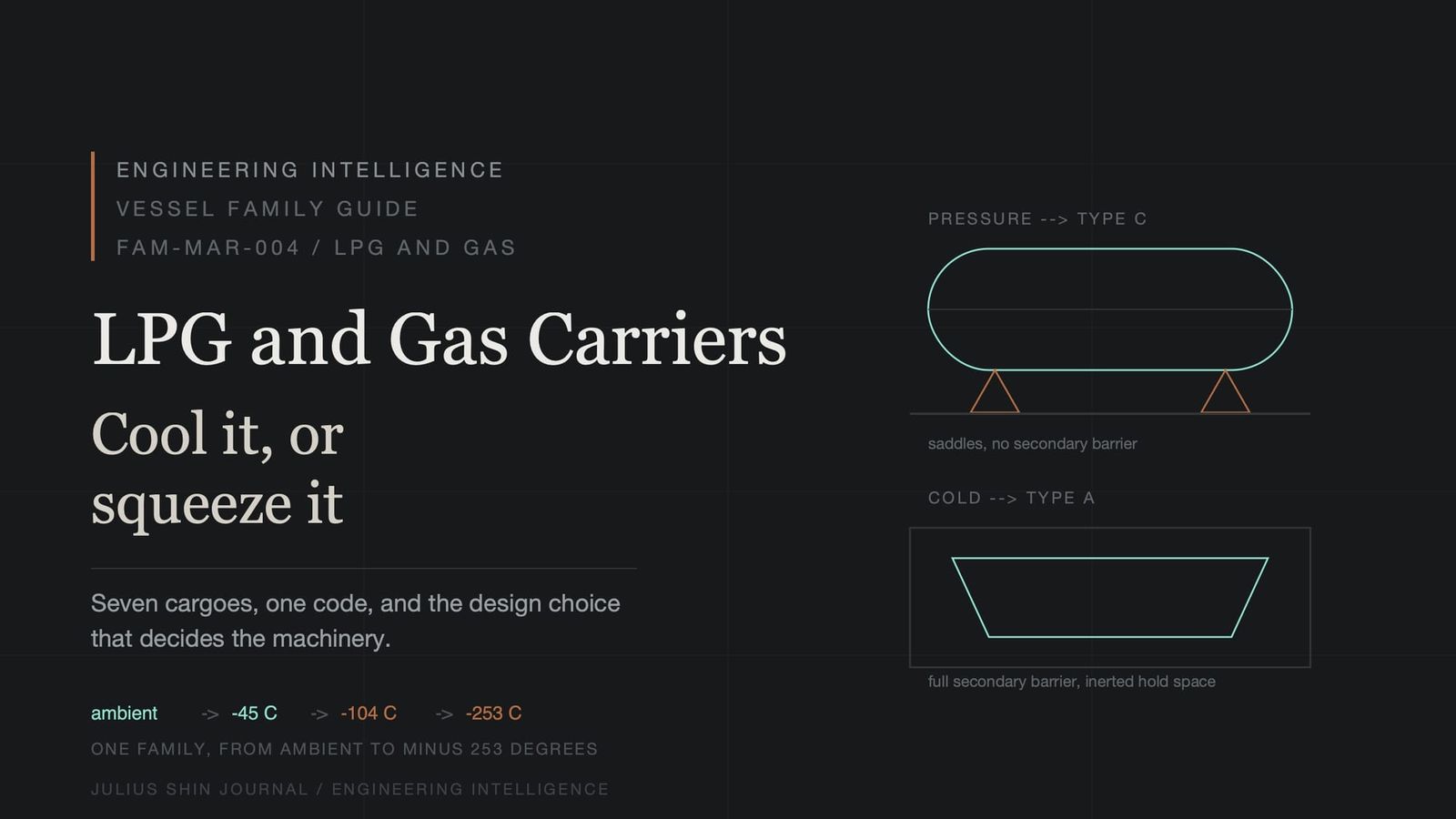
There are only two ways to turn a gas into a liquid — take heat out of it, or put pressure into it. Every ship in this family is an answer to which one, and that answer reaches all the way from the shape of the tanks to the plant in the machinery spaces to the products written on the certificate.
This is a working guide to a family of seven vessel types: what they carry, how they are laid out, what they repeat every voyage, and what governs them. It is groundwork rather than argument. Read it and the articles on individual vessel types and individual systems should land with somewhere to sit.
The cargo does not decide this ship. The state you choose to hold the cargo in decides this ship.
Part I — What This Ship Is For
1. What it carries
Substances that are gases at ambient temperature and pressure. That is the only thing every member of this family has in common. Propane and butane, ethylene and ethane, ammonia, carbon dioxide, hydrogen — chemically they are near strangers to one another, but from the ship's point of view they pose one identical problem. They cannot be carried as gases. The volume is impossible. So they have to be made into liquids, and physics offers exactly two ways of doing that.
Take heat out, or put pressure in.
Those two handles are the whole of this family. And the decisive fact is that not every cargo can use both of them. This is where critical temperature enters. Above its critical temperature a substance cannot be liquefied at all, no matter how hard it is squeezed. The pressure handle simply disappears.
- Methane's critical temperature is about −82 °C TYPICAL. At any temperature the sea can produce there is no pressure that will make it a liquid. An LNG carrier therefore has no choice to make.
- Ethylene's critical temperature is about +9 °C TYPICAL. In a warm sea, pressure alone will not hold it either.
- Propane, butane and ammonia have critical temperatures comfortably above anything a ship will meet at sea. They can be held as liquids at ambient temperature by pressure alone.
That is the fork this family sits on and LNG does not. LNG is a problem with one answer. This is a problem with several, which is why two ships carrying the same cargo can look nothing like each other.
The range of states involved is unusually wide TYPICAL:
- Temperature: from ambient down to −253 °C
- Pressure: from near-atmospheric up to roughly 18 barg
- Atmospheric boiling points across the family: propane around −42 °C, propylene around −48 °C, ammonia around −33 °C, ethylene around −104 °C
- Liquefied CO₂ is carried at one of two design points rather than across a range: low pressure, about 7 bar and −50 °C, or medium pressure, about 15 bar and −30 °C
Ambient temperature and −253 °C coexist inside one family. No other cargo-ship family covers a spread of states like that under a single code INFERRED.
The hazards arrive along three separate lines.
Flammability. Most of these cargoes have a combustion range in air. A leak goes straight to fire and explosion.
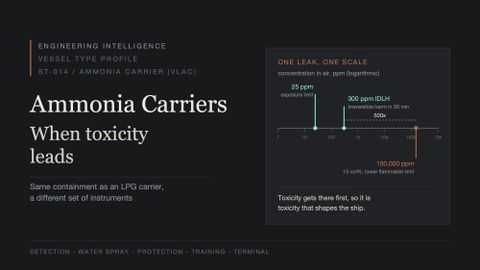
Toxicity. For some of them, toxicity arrives before flammability does. The IGC Code marks toxic products with a "T" in column f of its chapter 19 table TYPICAL. That is not a label; it is a design fork. A hazard whose correct answer is "disperse it quickly" and a hazard whose correct answer is "never disperse it" pull the ship in opposite directions.
Cold. Refrigerated cargoes will fracture ordinary hull steel in a brittle mode, and will injure a person on contact. A cargo can be neither flammable nor toxic and still be dangerous purely because of its temperature.
Two more properties sit underneath all of it. Every one of these cargoes is an asphyxiant — it displaces oxygen. And some of them polymerise: left alone they react with themselves and set. Those are carried with an inhibitor, and where the inhibitor is and how much of it is left becomes an operational question TYPICAL.
Carry substances that are gases at ambient
        |
        +--> they must be made liquid --> two ways: remove heat, or add pressure
        |                                     |
        |                                     +--> critical temp above ambient --> both work
        |                                     +--> critical temp below ambient --> cooling only
        |
        +--> flammable / toxic / cold --> protection points in different directions
        |                                 depending on which cargo is aboard
        |
        +--> heat always gets in --> it shows up as pressure, or as vapour
                                     --> what absorbs that rise IS the design
That last branch is the one to hold on to. No insulation stops heat entirely. Whatever gets in must appear either as a pressure rise or as boiling. Do you take that rise on the strength of the tank, or do you take it away with machinery? The answer to that single question separates every ship in this family from every other one.
2. What those properties demand
Translated from physical properties into functions there are six requirements. Still no equipment names.
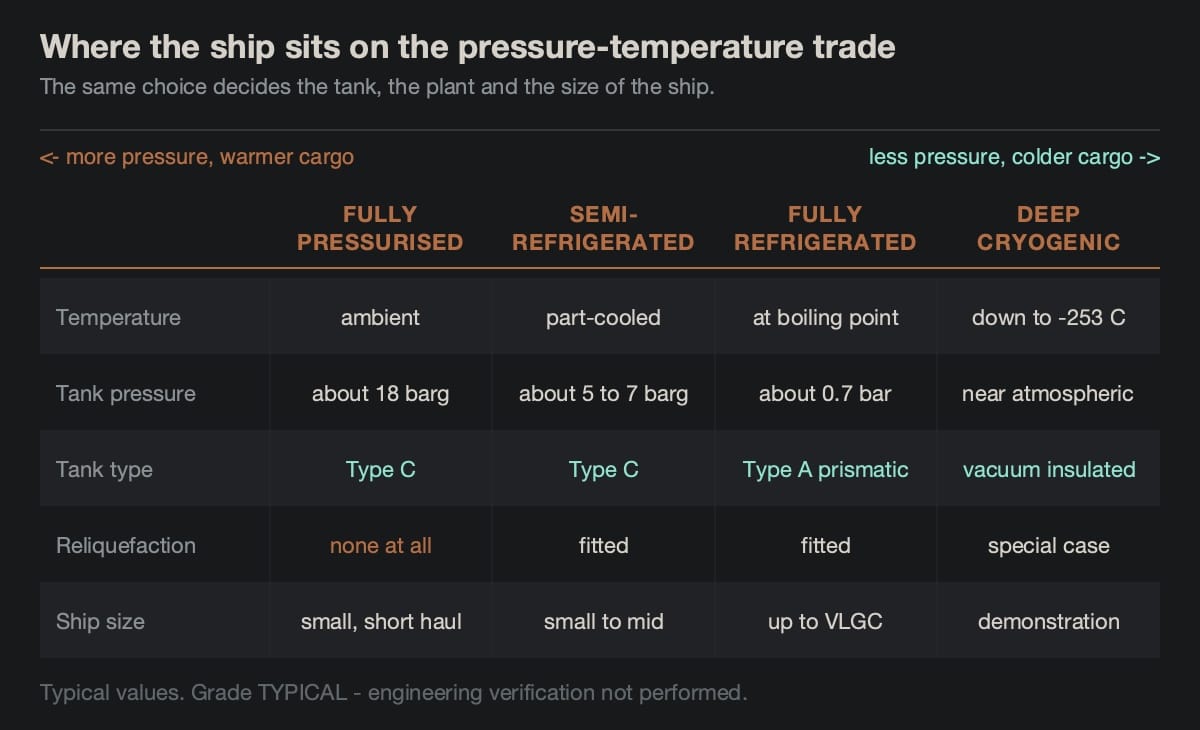
One: containment matched to a pressure–temperature pair. Other ships hold cargo. This ship holds cargo in a specified state. The containment envelope is designed against a state pair, not against a volume. And only one pair can be chosen — a vessel thick enough for 18 barg cannot be used at −104 °C, and a large box built of material good for −104 °C will not hold 18 barg. Choosing the state is choosing the ship.
Two: the ability to hold that state for the length of a voyage. There are two strategies. Endure it — build the vessel strong enough that the pressure rise from heat ingress does not matter. Remove it — take heat back out continuously, at the rate it arrives. The first is a structural solution; the second is a mechanical one. Which was chosen dictates what is bolted to the ship.
Three: control of the atmosphere. Cargo and air must not meet — and the places they could meet are not only inside the tank. The spaces between tank and hull, the piping, and the tank itself when the cargo is being changed all qualify. Each space has a specification for what gas should be in it right now, and changing that is itself an operation.
Four: conversion of state at the interface. This requirement belongs to this family alone. Whatever state the ship holds its cargo in, there is no guarantee the shore installation holds it in the same one. Putting cold liquid into ambient-temperature pressure storage means warming it, and the reverse is equally true. So this ship must be able not only to move cargo, but to change the cargo's state as it crosses the boundary.
Five: measurement that carries legal weight. The volume of a liquefied gas moves with temperature and pressure. How much was delivered is a matter of contract and taxation, so the measurement itself acquires legal standing.
Six: protection against three different kinds of leak. One that ignites, one that poisons, and one that cracks steel. No single protective measure covers all three.
Part II — How the Ship Is Built
3. General arrangement
The layout of these ships is produced by two rules laid over one another. One is the segregation rule this family shares with LNG carriers. The other is this family's own rule: where the tanks go.
Segregation. The IGC Code (3.1.1) requires hold spaces to be segregated from machinery and boiler spaces, accommodation and service spaces, control stations, chain lockers, domestic water tanks and stores. Where the containment system needs a complete or partial secondary barrier that segregation has to be a cofferdam or an oil fuel tank (3.1.3); where it does not, a single gastight all-welded "A-60" bulkhead is also accepted (3.1.2). Oil fuel tanks are therefore one of the permitted separating media, not one of the spaces to be separated from TYPICAL. It is worth noticing what the regulatory term "cargo area" covers (1.2.7): the cargo containment system, the cargo pump and compressor rooms, and the deck areas over the full length and breadth of the part of the ship above those spaces — but not the cofferdams, ballast or void spaces at the after end of the aftermost hold space or at the forward end of the foremost hold space, which the definition excludes TYPICAL. Those end spaces sit outside the cargo area. That is precisely how the separation works.
Where the tanks go — and here the family splits.
Large fully refrigerated ships use independent Type A prismatic tanks below deck. With a design vapour pressure below 0.7 bar — IGC 4.21.1.1 sets the limit at 0.07 MPa — these are not pressure vessels but very large boxes, and in exchange a full secondary barrier is mandatory TYPICAL. That produces a hold space between tank and hull, and when a flammable cargo is aboard that space must be inerted with inert gas or nitrogen. A very large gas carrier typically carries four such prismatic tanks below deck.
Pressurised and semi-refrigerated ships use Type C pressure vessels. Horizontal cylinders sit on two or more saddles, and they may be fitted on deck, below deck or partly below, arranged either longitudinally or transversely TYPICAL. A plain cylinder wastes the ship's section, which is why the bilobe form exists — two cylinders of equal diameter intersecting at about 80 % of their diameter with an internal longitudinal bulkhead along the join, built to diameters of around 15 m. Type C requires no secondary barrier, and where such a tank sits inside the hull the hold space may be filled with inert gas or simply with air. Deck tanks on LPG carriers use this type.
The shape is not the lesson; the causation is. Choose pressure and you get a cylinder; a cylinder can go on deck; the secondary barrier disappears; the ship gets simpler and the tank gets heavy. Choose near-atmospheric and you get a prismatic box; the box goes below deck; a full secondary barrier and an inerted hold space come with it; and the ship can get very large. The choice made in Section 1 becomes steel here.
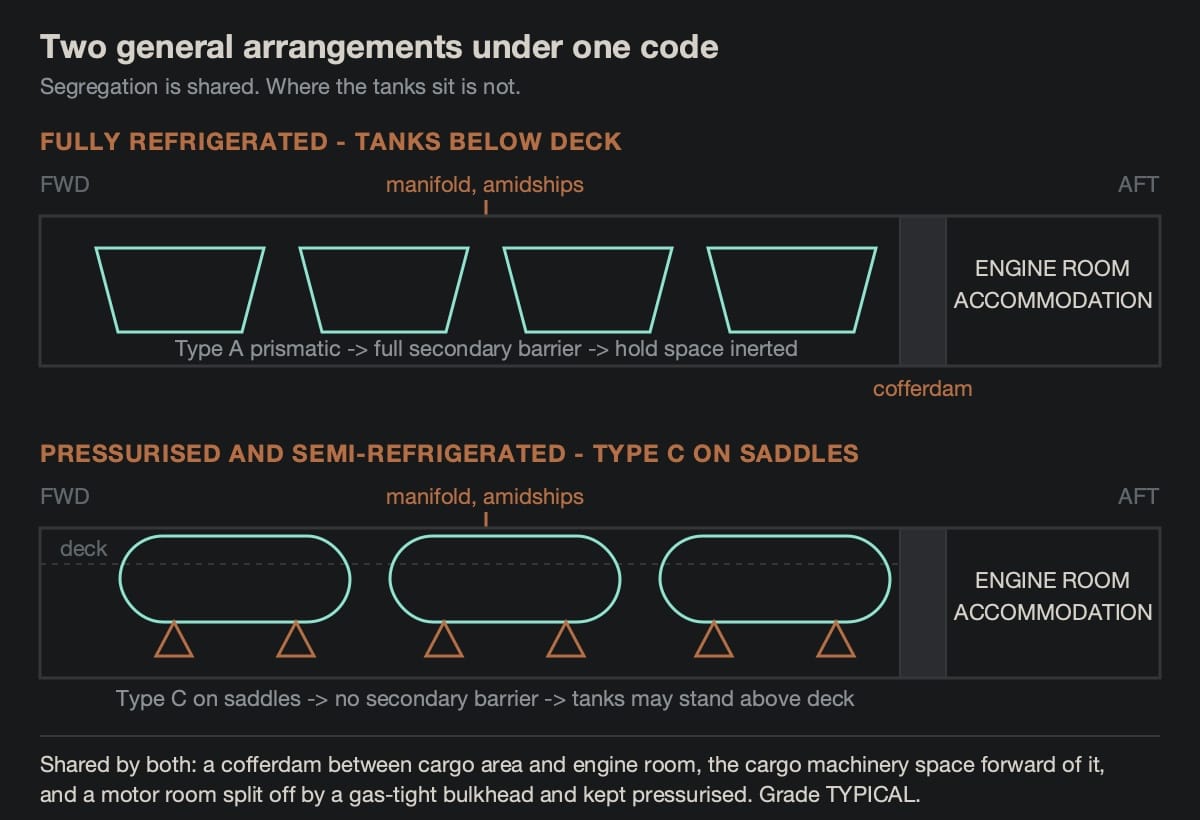
The cargo machinery space. The compressor room is normally arranged aft — on the side where the engine room and deckhouse are — above the tank space, with a cofferdam between TYPICAL. One arrangement principle deserves emphasis because it recurs throughout gas-carrier design: the compressors and their electric motors are not in the same room. In the usual arrangement they are divided by a bulkhead or deck whose shaft penetration is sealed to give effective gastight segregation, and the motor room is kept at overpressure. IGC 3.3.4 also permits the alternative of certified safe motors placed next to the machines, so this is the common arrangement rather than the only permitted one.
Zoning and air locks. The cargo area is a hazardous area, which the IGC Code (1.2.24) defines as an area in which an explosive gas atmosphere is, or may be expected to be, present in quantities requiring special precautions for the construction, installation and use of equipment. The older "gas-dangerous space" wording belongs to the pre-2016 text and no longer appears in the Code TYPICAL. Walking directly from a hazardous area below the weather deck into a non-hazardous one is not permitted. Hence the air lock, which IGC 3.6.1 requires for access between a hazardous area on the open weather deck and a non-hazardous space: two self-closing, substantially gastight steel doors, the airlock ventilated from a non-hazardous area and held at overpressure to the weather deck, spaced not less than 1.5 m and not more than 2.5 m apart. Gas detection is typically catalytic-bead or infrared with continuous readout in the cargo control room.
The manifold. Liquid and vapour manifolds are ideally located amidships; the SIGTTO/OCIMF manifold recommendations place the longitudinal centre of the cargo manifold at the middle of the ship's length, or as near to it as is physically possible TYPICAL. The arrangement has its own rule: the liquid connections sit at the outer ends of the manifold group and the vapour connections inboard of them — the "LVVL" arrangement. The loading line runs down through the tank to the bottom; the vapour connection is taken from the top. The plain fact that this ship connects to the shore with two lines rather than one explains most of what happens alongside.
[FWD]                                                             [AFT]
 +---------------------------------------------------+---------------+
 |                      CARGO AREA                    |cofferdam| ER  |
 |                                                    |         |acc. |
 |  below deck, Type A prismatic:                     |         |     |
 |     full secondary barrier + inerted hold space    |         |     |
 |  or                                                |         |     |
 |  Type C cylinder / bilobe on saddles:              |         |     |
 |     no secondary barrier, may sit on deck          |         |     |
 +-----------------------+----------------------------+---------------+
                         |                                  ^
              manifold, amidships               cargo machinery space
     liquid -- vapour -- vapour -- liquid       compressor room | motor room
        (liquid outermost: L-V-V-L)             gas-tight bulkhead, sealed shafts
                                                motor room kept pressurised
4. The main system groups
Grouped by what they do, the equipment falls into six clusters.
| Group | Systems on this family | What it does |
|---|---|---|
| Holding it | Cargo containment (independent Type A / B / C) | Keeps the cargo in the chosen pressure–temperature state |
| Moving it | Deepwell and submerged cargo pumps; liquid and vapour headers; remote-controlled cargo and ballast valves | Makes cargo flow between tank and shore |
| Making the state | Cargo compressors (HD / LD); reliquefaction and reconditioning; cargo vaporizers and heaters; N₂ generator (membrane / PSA) | Brings the cargo to the required pressure and temperature and holds it there |
| Measuring it | Cargo tank instrumentation (level, temperature, pressure); radar level gauging; transfer metering | Turns state and quantity into numbers |
| Watching it | Gas detection; cargo control console; cargo machinery room ventilation | Keeps confirming what is where |
| Protecting it | Cargo ESD; ship–shore ESD link; water spray and deluge; dry powder; venting and mast risers | Stops, isolates, cools and vents when something goes wrong |
The third cluster is this family's identity. On other cargo ships, equipment that "makes a state" is auxiliary. Here it is the condition under which the cargo exists at all.
And the make-up of that cluster is not the same from ship to ship — which is exactly what makes this a family rather than a type.
What absorbs the heat that gets in?
        |
        +--[1]--> the strength of the tank  --> pressure rises, and that is the end of it
        |                                       (there is no machine -- see Section 5)
        |
        +--[2]--> machinery removes it      --> draw the vapour off and put it back as liquid
        |                                       (compressors + reliquefaction)
        |
        +--[3]--> burn it                   --> use part of the cargo as fuel
                                                (a comparatively recent answer here)
The third branch used not to be this family's answer at all. It is now: in the medium gas carrier segment (roughly 30,000–50,000 m³) about 83 % of the orderbook was reported as dual-fuel in Drewry's 2025 review, and BW LPG states that 22 of its fleet of around 50 very large gas carriers run LPG dual-fuel propulsion. An equivalent figure for the VLGC orderbook as a whole was not found, so the trend is stated here only where it was sourced TYPICAL. This family is in the middle of learning the third answer.
Two items in the protective cluster are required outright. Ships carrying flammable or toxic products must have a water spray system for cooling, fire prevention and crew protection, covering, among the eight areas listed in IGC 11.3.1, exposed cargo tank domes and exposed parts of cargo tanks, exposed on-deck storage vessels, deck-mounted gas process units, the cargo liquid and vapour discharge and loading connections, all exposed ESD valves in the cargo lines, and the exposed boundaries facing the cargo area of superstructures and deckhouses that are normally manned; remote starting of its pumps and remote operation of normally closed valves must be arranged outside the cargo area, adjacent to the accommodation (11.3.7) TYPICAL. Ships intending to carry flammable products must have a fixed dry chemical powder system for deck fires in the cargo area, able to deliver powder to any part of the exposed cargo liquid and vapour piping, the load/unload connections and exposed gas process units from at least two hand hose lines or a monitor-and-hose combination (IGC 11.4.1–11.4.2). The rates are per outlet, not per system: a hand hose nozzle discharges at not less than 3.5 kg/s and a monitor at not less than 10 kg/s (11.4.4).
5. What this ship does not have
Absence sometimes explains a ship as well as presence, and this family is the clearest case of it.
The reference source records the absence in a single line: on pressurised units, reliquefaction entirely.
That is not equipment left out. It is the same job done a different way. A fully pressurised ship carries its cargo at ambient temperature. Because the cargo sits at the temperature of its surroundings there is no large standing temperature difference driving heat into it, and what warming does occur — season, sunshine, a hot loading port — appears as a rise in pressure, which a Type C tank with a design pressure around 18 barg simply takes TYPICAL. The pressure rise is absorbed by structure instead of being removed by machinery. Such ships therefore have neither a reliquefaction plant nor insulation.
The price is exact. A tank with that design pressure is very heavy; heavy tanks limit how large the ship can be; a small ship does not suit long-haul trade. So pressurised ships are small and work short routes. Choose near-atmospheric carriage instead and the tanks get lighter and the ship can grow to VLGC size — but now a plant has to run for the whole voyage.
The list of absences continues.
Type C tanks require no secondary barrier TYPICAL. The Code states the reason itself: IGC 4.4.4 dispenses with a secondary barrier for containment systems, "e.g. type C independent tanks", where the probability of structural failure and of leakage through the primary barrier is extremely low and can be neglected, and table 4.5 carries "no secondary barrier required" against type C at every cargo temperature VERIFIED. It stands in exact contrast to the full secondary barrier demanded of the below-deck Type A tank. Two different safety philosophies live inside one family, and both descend from the choice made in Section 1.
There is no deck cargo gear and there are no hatches. A cargo that flows through pipes needs nothing to lift it with. What fills the deck instead is piping, tank domes and vent masts — and on pressurised and semi-refrigerated ships, sometimes the tanks themselves.
Part III — What It Repeats
6. The voyage cycle
A list of systems does not explain why a given piece of equipment exists as its own system. The voyage cycle does.
One cycle on a refrigerated gas carrier runs roughly like this TYPICAL.
| Stage | What happens | Systems in play |
|---|---|---|
| Drying | Moisture is removed from tanks and lines, to prevent ice during cooling and to protect cargo quality | Dry air plant |
| Inerting | Inert gas is supplied to tanks and piping to create a non-explosive atmosphere; the source is an inert gas generator or nitrogen | IG generator / N₂ generator |
| Gassing up | Cargo liquid is vaporised on board and admitted slowly to the top or bottom of the tank — which end depends on relative vapour density — displacing the inert gas to other tanks or to the vent riser | Vaporizers, vapour header, venting |
| Cooling down | Tanks and piping are cooled gradually, to avoid thermal-shock damage and to limit boil-off during loading | Cargo pumps and sprays, compressors |
| Loading | Cargo comes aboard; the vapour it displaces is returned ashore or reliquefied | Liquid header, metering, ESD link |
| Laden voyage | The heat that gets in is dealt with — endured as pressure, reliquefied, or burned | Compressors and reliquefaction, or nothing at all |
| Discharge | Cargo goes ashore, warmed on the way out if the receiving storage is pressurised | Cargo pump + booster pump + cargo heater |
| Ballast voyage | Tank condition is managed for the next cargo | Compressors, instrumentation |
| Warm-up / gas freeing | Tanks are warmed and gas-freed with dry air until 20.9 % oxygen is read throughout | Heaters, IG plant in dry-air mode |
| Grade change | If the next cargo is different, the tank atmosphere is changed | Nitrogen, venting, instrumentation |
Two of those stages show what kind of ship this is.
Discharge is not simply emptying. When a refrigerated ship discharges into pressurised shore storage the cargo has to be warmed, and that means running a booster pump and a cargo heater in series with the main cargo pump TYPICAL. The heater is a deck-mounted horizontal shell-and-tube exchanger with cargo liquid on the shell side and sea water on the tubes. Even the order of operations is fixed: establish sea water flow through the heater first, then cool the booster pump and heater down slowly on a small throughput of liquid before going to full rate. And while the booster pump is in the line, the pump discharge valve is not used for flow control, because the booster pump may cavitate. If no vapour return line is provided from shore, vapour has to be supplied to hold tank pressure during discharge. The fourth demand of Section 2 — change the state at the boundary — becomes hardware right here.
Grade change is a routine operation. Ships in this family do not carry one cargo for life. When the cargo changes the tank atmosphere has to change, and there are two methods: displacement and dilution TYPICAL. The difficulty depends entirely on the combination. A fully refrigerated ship moving between compatible LPG grades may need no more than a vapour change, while a semi-refrigerated or fully pressurised ship switching to an incompatible cargo may need a full tank clean, followed by visual inspection and a nitrogen purge. How far the oxygen has to be brought down is set by the next cargo, not by the ship: around 2 % by volume is usually accepted for LPG grades, while cargoes such as VCM and butadiene are quoted as low as 0.1 %. Where the change is from ammonia to a hydrocarbon, residual ammonia is controlled down to parts per million — sources quote different limits, so no single figure is given here UNKNOWN. On ships that run reliquefaction, additional inhibitor may have to be injected so that it does not accumulate in the condenser and condensate return line.
The simple fact that one ship carries several cargoes generates an entire operation that no system list shows. That is the operational difference between this family and a single-cargo family.
7. Alongside: what the terminal requires
At sea this ship is a closed system. The moment it comes alongside it acquires a counterparty.
It begins with procedure. On arrival, a Ship/Shore Safety Checklist is completed jointly by a responsible ship's officer and the terminal supervisor, and no cargo operation of any description starts before it is complete TYPICAL. Earlier than that — before a particular ship first calls at a particular jetty — a compatibility study is carried out between ship operator and jetty operator. SIGTTO and OCIMF have published manifold arrangements and cargo strainer guidance for LPG and LNG carriers in a single document, and SIGTTO publishes separate guidance on the gas carrier and terminal gangway interface.
The shutdown function is shared. A linked ESD system works at two levels: ESD1 stops the cargo operation by closing valves and stopping pumps, and ESD2 activates the emergency release system and disconnects the terminal's transfer arm TYPICAL. The powered emergency release coupling (PERC) that performs the disconnection uses stored energy so that it will break out through ice build-up; on initiation the valves close and then the coupling separates, with the elbow section remaining attached to the ship.
It must also physically fit. SIGTTO recommends four link connector arrangements — fibre-optic 6-pin, electric 37-pin, electric 6-pin and electric 5-pin — where the fibre-optic and 37-pin types carry communications alongside the shutdown signal, while LPG vessels typically use the electric 5-pin and 6-pin types TYPICAL.
But this family has something to agree on before the shutdown link: there is no guarantee the two sides hold the cargo in the same state.
   what the ship is holding             what the shore wants
   ------------------------             --------------------
   refrigerated, near atmospheric  -->   ambient, pressurised storage
                 |
                 +--> who warms it?      --> ship's booster pump + cargo heater
                 +--> where does the     --> is there a vapour return line, or not?
                 |    vapour go?
                 +--> what holds tank    --> if no return, the ship must make vapour
                      pressure up?
An oil tanker comes alongside and agrees a rate and a pressure. A ship in this family has to agree a temperature and a phase first. That is why the manifold carries two lines instead of one, and why the compatibility study is a substantive piece of work rather than a formality.
Where gas is transferred as fuel rather than as cargo, the governing document changes entirely. ISO 20519 is scoped, in its own title, to the bunkering of LNG-fuelled vessels, and it fills ground the IGC Code does not cover TYPICAL. It sets five elements: liquid and vapour transfer hardware; operational procedures; the provider's obligation to issue a bunker delivery note; training and qualification of personnel; and compliance of the facility with applicable standards and local codes. The hardware scope includes hoses, transfer arms, bunkering connections, dry-disconnect/connect couplings and insulating flanges. So a third document — neither the cargo code nor the fuel code — attaches to this interface, even though the physical act is nearly the same one.
Part IV — What Governs It
8. The rules and the certificate
This family sits under the IGC Code, the international code for the construction and equipment of ships carrying liquefied gases in bulk.
The most useful way to read the IGC Code here is as a code that sorts ships by hazard. It defines four ship types TYPICAL:
- 1G — for products requiring maximum preventive measures against escape. Such a ship must survive the most severe standard of damage, and its cargo tanks must be located at the maximum prescribed distance inboard from the shell plating.
- 2G — for products requiring significant preventive measures.
- 2PG — a ship of 150 m in length or less carrying such products in independent Type C tanks designed for a MARVS of at least 7 bar gauge with a containment design temperature of −55 °C or above.
- 3G — for products requiring moderate preventive measures.
Which products fall where is set by the table in chapter 19. What the ship may carry therefore determines its structural class.
It is worth being explicit that there are two independent axes at work here. The cargo's state — pressure and temperature — decides the tank type and the machinery outfit. The cargo's hazard decides the IGC ship type and how far inboard the tanks must sit. They are not the same axis. Two ships with identical Type C tanks can fall into different ship types depending on what they carry, so containment arrangement alone should never be read as an indication of class INFERRED.
The certificate is a cargo list. The regulatory output of IGC compliance is the International Certificate of Fitness for the Carriage of Liquefied Gases in Bulk, issued by the flag state or by a recognised organisation acting for it TYPICAL. Without a valid one, no ship under a SOLAS-signatory flag carries IGC cargoes. The certificate runs for five years, with an annual survey within three months either side of each anniversary date, an intermediate survey within three months of the second or third anniversary, and a renewal survey of the same scope as the initial one.
Here is the part specific to this family: that certificate enumerates the products the ship may carry. The grade change of Section 6 happens inside that list. Carrying something outside it is not an operational decision but a certification one. The certificate defines the ship's commercial reach as directly as its speed or its capacity does.
The edges of the code matter too, because some of this family's cargoes are newer than the code that has to hold them.
- For liquefied hydrogen, IMO resolution MSC.420(97), adopted on 25 November 2016, contained Interim Recommendations for Carriage of Liquefied Hydrogen in Bulk VERIFIED. It was revoked and replaced on 24 May 2024 by resolution MSC.565(108), Revised Interim Recommendations for Carriage of Liquefied Hydrogen in Bulk, so MSC.420(97) is the historical instrument rather than the one now in force. Both ask, where vacuum insulation is adopted, that the possibility of untimely deterioration of the insulation properties at the envisaged carriage temperature be considered, and that supporting and adjacent hull structure be designed taking into account the cooling owing to loss of vacuum.
- For liquefied CO₂, amendments addressing the cargo and the certificate are reported to be in progress, with chapter 19 work on higher purities and larger volumes than the established food-grade trade under discussion at sub-committee level TYPICAL. Dates have been reported but the source instruments were not checked, so none are given here.
⚠ The regulatory statements above are consistent across multiple technical sources, but some IGC clause numbers remain unverified. In the independent verification pass the following were read in the IGC Code (2016 edition) itself and matched the text above: 1.2.7 cargo area, 1.2.24 hazardous area, 1.2.53 the "T" in column f, 2.1.2 ship types 1G/2G/2PG/3G, 3.1.1–3.1.3 segregation, 3.3.4 compressor and motor rooms, 3.6.1 airlocks, 4.4.4 and table 4.5 secondary barriers, 4.21.1.1 type A design vapour pressure, 1.4.2 the survey cycle, and 11.3.1, 11.3.7 and 11.4.1–11.4.4 water spray and dry powder. Clause numbers not named here are still unverified.
One last distinction. The IGC Code governs ships that carry liquefied gas as cargo; ships that burn gas as fuel fall under the IGF Code. The third branch of Section 4 — the ship that burns its own cargo — sits at the intersection of the two.
9. The people
Equipment is not the only thing regulated.
STCW sets two tiers for liquefied gas tankers TYPICAL: basic and advanced. The advanced tier is for masters, chief engineers, chief mates, second engineers, and others with immediate responsibility for loading, discharging and care in transit.
A course on its own does not produce it. The candidate must already hold the basic certificate, must complete approved advanced training, and on top of that must have at least three months of approved seagoing service on liquefied gas tankers, or at least one month of approved onboard training in a supernumerary capacity including at least three loading and three unloading operations recorded in an approved training record book. The standard of competence is the one set out in section A-V/1-2, paragraph 2 of the STCW Code.
What is worth noticing in this family is how wide that endorsement is. STCW recognises one category — "liquefied gas tanker" — and within the sources consulted there is no cargo-specific sub-endorsement. It follows that an officer who qualified on a propane carrier may serve, on the same endorsement, aboard an ammonia carrier INFERRED. As Section 1 showed, those two cargoes carry hazards of different character that point protection in different directions, and the competence regime does not draw that line.
The gap is closed outside the regulation — by company cargo-specific procedures, by terminal requirements, and by inspection and vetting regimes. When reading this family, this is the clearest place where "what the rule requires" and "what is actually required" come apart.
Part V — Orientation
10. The vessel types in this family
| ID | Vessel type | Korean | Distinguishing line |
|---|---|---|---|
| ST-011 | LPG Carrier | LPG운반선 | Propane and butane, pressurised or refrigerated — the containment choice decides whether a reliquefaction plant exists at all |
| ST-012 | Ethylene Carrier | 에틸렌운반선 | −104 °C; reliquefaction is mandatory |
| ST-013 | Ethane Carrier (VLEC) | 에탄운반선 | Very large ethane carrier, typically dual-fuel burning its own cargo |
| ST-014 | Ammonia Carrier (VLAC) | 암모니아운반선 | Fully refrigerated; toxicity, not flammability, leads the hazard profile |
| ST-015 | CO₂ Carrier | CO2운반선 | Liquefied CO₂ for CCS chains; regulation still developing |
| ST-016 | Liquefied Hydrogen Carrier | 액화수소운반선 | −253 °C in vacuum-insulated tanks; demonstration stage |
| ST-062 | LNG / Gas Bunkering Vessel | LNG·가스 벙커링선 | Transfers gas fuel to receiving ships; vapour return and custody transfer are the interface |
Cargo characteristics, the equipment that identifies each ship, the shift in its hazard profile and its hull and route constraints belong to the vessel-type articles. This table is a map, not a summary.
11. The nearest relatives
The LNG carrier is the closest. Same IGC Code, same Certificate of Fitness, same STCW endorsement, same cofferdam segregation, same ship–shore ESD link. Even the approach to a berth looks much alike.
The difference is the number of available answers. An LNG carrier solves a problem with one solution: methane's critical temperature is so low that the pressure handle does not exist, so every LNG carrier ends up in substantially the same place. This family solves a problem with several. Which is why knowing LNG carriers will let you understand one ship here, but will not explain why the seven look so different from one another.
There is a second difference, and it is moving. LNG carriers were built around burning their own cargo from the beginning; this family has only recently started adopting that answer. A feature that used to distinguish LNG carriers is migrating into this family.
Chemical tankers come next, and the overlap is in an unexpected place: the certificate. A chemical tanker's certificate also lists the products the ship may carry, the tank must also be prepared when the cargo changes, and cleaning and compatibility also sit at the centre of operations. What differs is phase. A chemical tanker's cargo is already liquid at ambient temperature and its danger comes from chemistry. The danger in this family comes from the fact that the cargo's liquid state is artificial and has to be maintained.
Oil tankers share the berth culture, the manifold conventions and the way of thinking about a linked shutdown. But crude oil does not build pressure inside a tank. An oil tanker's cargo sits still; this family's cargo does not.
At the far end are passenger ships, where the equipment comes from carrying people rather than from the physical properties of a cargo.
12. Where to go next
This article is groundwork. Real understanding comes from going down into the individual systems. In this family, in order:
- Cargo containment, Type A / B / C — what the fork in Section 3 looks like as actual structure.
- Cargo compressors and reliquefaction — the inside of the second branch of Section 4. It is fitted to more ships in this family than any other cargo machinery, and it is where the operational trouble usually is.
- Cargo tank instrumentation and radar level gauging — where a state becomes a number.
- Cargo ESD and the ship–shore link — the inside of the shared shutdown function of Section 7.
- Gas bunkering transfer and vapour return — how the ST-062 interface actually works.
- Nitrogen generation and inerting — the whole atmosphere-management thread of Section 6 hangs on it.
The short version
- This family is defined by a choice, not by a cargo. Take heat out or put pressure in — and that choice decides the tank type, whether a reliquefaction plant exists, and much of the machinery outfit.
- Critical temperature decides whether the choice exists at all. Methane has no choice; propane does. That single fact is why LNG carriers resemble each other and these ships do not.
- Absence is design. A pressurised ship has no reliquefaction plant not because equipment was omitted but because the pressure rise is taken by structure instead of machinery.
- The state changes at the interface. These ships do not merely move cargo; they warm it, cool it and trade vapour across the boundary.
- The certificate is a cargo list. What may be carried is written down, and that document defines the ship's commercial reach.
[FINAL CHAIN]

gas at ambient --> must be made liquid --> remove heat, or add pressure
                                            |
        +-----------------------------------+-----------------------------------+
        |                                   |                                   |
  the tank type splits            the machinery splits              the certificate
  (Type C cylinder /              (reliquefaction present /         names the cargoes
   Type A prismatic)               entirely absent)                 (1G/2G/2PG/3G + CoF)
        |                                   |                                   |
        +-----------------------------------+-----------------------------------+
                                            |
                        seven different ships under one code
Sources
- Workbook Ship Classification and Systems — system lists, family applicability, vessel type taxonomy
- Maritime Systems Atlas public projection — review status: reference taxonomy; engineering verification not performed
- Gas carrier containment and general arrangement (independent Type A/B/C, saddles, bilobe form, secondary barrier, inerted hold spaces, compressor and motor room separation, air locks, amidships manifold) — multiple technical sources
- Voyage cycle (drying, inerting, gassing up, cooling down, discharge via booster pump and cargo heater, gas freeing to 20.9 % oxygen, grade change with a cargo-dependent nitrogen purge) — multiple technical sources
- IGC Code (2016 edition) — ship types 1G / 2G / 2PG / 3G (2.1.2), International Certificate of Fitness and its survey cycle (1.4.2, 1.4.4), segregation (3.1), airlocks (3.6.1), secondary barriers (4.4, 4.5), fire protection (11.3, 11.4) — read against the Code text
- IMO resolution MSC.420(97), Interim Recommendations for Carriage of Liquefied Hydrogen in Bulk — resolution number, date and title confirmed; revoked and replaced by MSC.565(108) on 24 May 2024
- STCW basic and advanced liquefied gas tanker training and its sea-service prerequisites
- Terminal interface practice — Ship/Shore Safety Checklist, compatibility study, linked ESD1/ESD2, powered emergency release coupling, ship–shore link connectors, SIGTTO and OCIMF guidance — and ISO 20519 for LNG bunkering
Article Classification
- Class: Engineering Intelligence — vessel family guide
- Evidence profile: reference taxonomy dataset plus public technical literature. No engineering verification was performed, so the default grade is TYPICAL. Clause numbers listed in the note at the end of Section 8 were read against the IGC Code text in an independent verification pass; those not listed remain unverified
- Scope: Family reference profile. Applicability by vessel type, project or contract is not verified. Operational figures are typical values and vary by ship, by cargo and by charter