On this page
This ship holds its cargo the same way an LPG carrier does. Fully refrigerated, near atmospheric pressure, and — as gas carriers of this size normally are when they carry a fully refrigerated cargo — prismatic tanks below deck TYPICAL. It is the picture the family guide already drew. And yet the gas detectors are different, the water spray is there for a different reason, the protective equipment is graded differently, and the terminal procedure is longer. When the containment is identical and the safety outfit is not, the thing that changed is not the state of the cargo. It is the hazard.
This article follows one shift — from flammability to toxicity — as far across the ship as it reaches. The physics of liquefied gas, the IGC regime in general, the containment types, the skeleton of the voyage cycle and the shape of the terminal interface are already laid out in the LPG and gas carrier family guide. Everything below is what differs on this one ship.
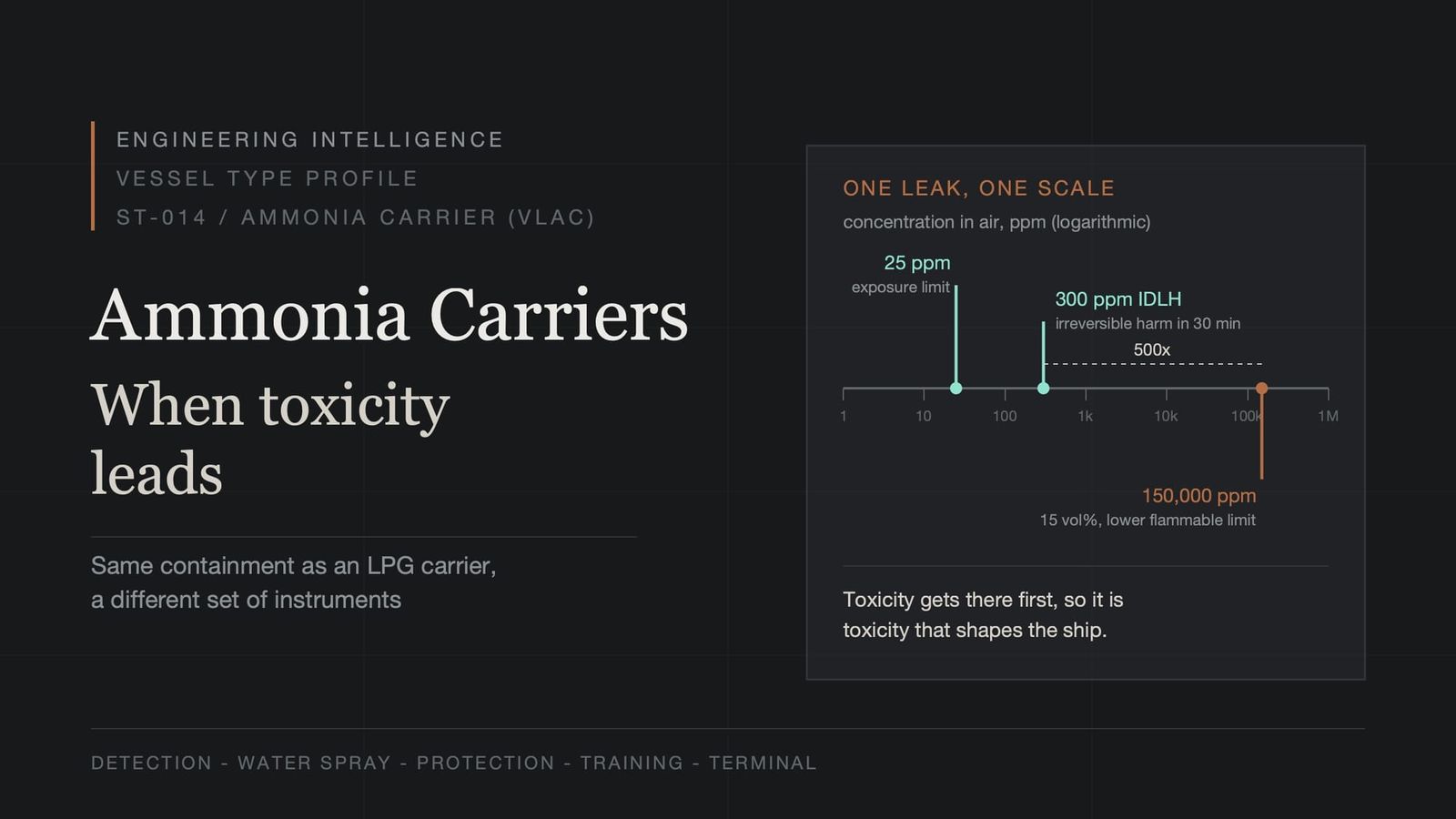
Flammability does not become a problem until the concentration reaches 15 %. Toxicity has already disabled at 0.03 %. Measure the same leak on two scales and the answers are five hundred times apart.
Part I — The Difference
1. The one line, opened up
The reference taxonomy leaves exactly one sentence about this vessel type.
Fully refrigerated ammonia carrier; toxicity, not flammability, leads the hazard profile — detection and water spray differ accordingly.
That is a claim, not an explanation. The numbers do the explaining.
Ammonia is not a non-flammable substance. It burns in air between 15 vol% and 28 vol%. Its autoignition temperature is 651 °C, its minimum ignition energy is far higher than that of the hydrocarbons in this family, and its flame propagates slowly. A narrow band, a high ignition threshold and a sluggish flame: judged purely as a flammable material, ammonia is one of the easier cargoes on a gas carrier.
The question is when that flammability starts to matter. Convert the lower flammable limit of 15 vol% into parts per million and it is 150,000 ppm. Ammonia's IDLH concentration — immediately dangerous to life or health — is 300 ppm. The NIOSH recommended exposure limit is 25 ppm as a time-weighted average — NIOSH bases its TWA on a working day of up to ten hours — with a 35 ppm short-term limit over fifteen minutes. The Emergency Response Planning Guidelines draw three lines of their own: 25 ppm for mild reversible effects, 150 ppm for serious irreversible effects, 1,500 ppm for life-threatening conditions.
Put the three-digit number next to the six-digit one and the design logic of this ship appears in a single stroke. The concentration at which a person suffers irreversible harm within half an hour is roughly one five-hundredth of the concentration at which the gas can burn. An instrument scaled for flammability begins to move its needle long after a toxic accident has finished happening.
So "toxicity leads the hazard profile" does not mean ammonia will not burn. It means toxicity arrives first. Once the order changes, what you detect first, what you defend against first and whom you evacuate first all change with it. The rest of this article follows that reordering across the ship.
And there is a second property of the same shift, less often stated. A flammability event ends — it ignites or it does not. A toxicity event continues. The vapour cloud stays poisonous until it disperses, the water used to knock it down remains, and ammonia that has soaked into the tank surface follows the ship into its next cargo. That persistence is the backbone of sections 6 and 7.
2. What causes it
Critical temperature, the two routes to liquefaction and what fully refrigerated containment means were dealt with upstairs. Here we take only the four properties that change for this cargo specifically. All four support the sentence above.
One: the hazard threshold is measured in parts per million. Those are the numbers already given. In practice, what this changes is the meaning of the word "detectable". The odour threshold is around 5 ppm, so a person often knows before an instrument does — but the sense of smell is rapidly deadened at high concentrations, which means the disappearance of the smell is not a safety signal. The instrument has to stand in for the nose, and its scale is not a percentage.
Two: the vapour density is 0.6, and released ammonia still sinks. Pure ammonia gas is lighter than air (air = 1). The textbook conclusion is that it rises, and once it warms, it does. But not at the moment refrigerated liquid escapes. Rapid depressurisation atomises the liquid into a fine aerosol, the heat of vaporisation chills everything around it, and that cold condenses moisture out of the atmosphere. The resulting droplet-and-vapour mixture is denser than the surrounding air. A visible white cloud runs low along the deck, and it is thickest at the height of a standing person.
This one fact makes detector placement genuinely hard. IGC 13.6 requires the position of fixed sampling heads to be determined with due regard to the density of the vapours of the products intended to be carried, and to the dilution produced by purging or ventilation. For a cargo with one density that is a simple instruction. For ammonia there are two answers — low at first, high later.
Three: it dissolves in water to an extreme degree. Ammonia dissolves into water to form ammonium hydroxide (NH₄OH). Because of that property, water on this ship is an absorbent rather than a coolant. For the flammable cargoes in this family the first purpose of water spray is cooling and radiant-heat shielding; here, knocking a vapour cloud out of the air comes first. Two consequences follow. The ammonium hydroxide produced is an alkaline, corrosive liquid, and ammonia-contaminated water is acutely toxic to aquatic life. On this ship water is simultaneously the response and a second source of contamination. Section 7 takes that contradiction head-on.
Four: the cargo attacks the containment itself. Anhydrous ammonia causes stress corrosion cracking in carbon-manganese and nickel steels. The cracks look small at the surface and grow deep, in the worst case through the full plate thickness. The other cargoes in this family are broadly neutral towards the tank INFERRED — they may be cold, or highly pressurised, or flammable, but they do not eat the steel. Ammonia does. Which is why the IGC Code wrote a clause specifying materials and heat treatment for this one cargo. Section 8 is that clause.
[CHAIN 1] What moves when the leading hazard changes

carry ammonia fully refrigerated
        |
        +--> lower flammable limit 15 vol% = 150,000 ppm  --+
        |                                                   |--> the two scales sit
        +--> IDLH 300 ppm / REL 25 ppm                    --+    ~500x apart
                                                                       |
                                                                       v
                                        toxicity arrives first = the leading hazard changes
                                                                       |
   +------------------+-----------------+-----------------+------------------+
   |                  |                 |                 |                  |
 the scale         the role of        the grade of      what training      the radius of
 of detection      water              protection        is about           the emergency
 %LEL -> ppm       cool -> absorb     flame -> intake   fire -> exposure   hull -> community
   |                  |                 |                 |                  |
   +------------------+-----------------+-----------------+------------------+
                                        |
                    but the water used to absorb it becomes toxic effluent
                    --> the response principle contradicts itself (section 7)
Part II — How the Difference Shows
3. Where it diverges from the family arrangement
An honest statement first. From public sources it is not possible to say how the general arrangement of a VLAC differs, at drawing level, from a VLGC of the same size. Number of tanks, tank form, deckhouse position, manifold layout — the most honest reading available today is that it is the fully refrigerated gas carrier arrangement the family guide already described.
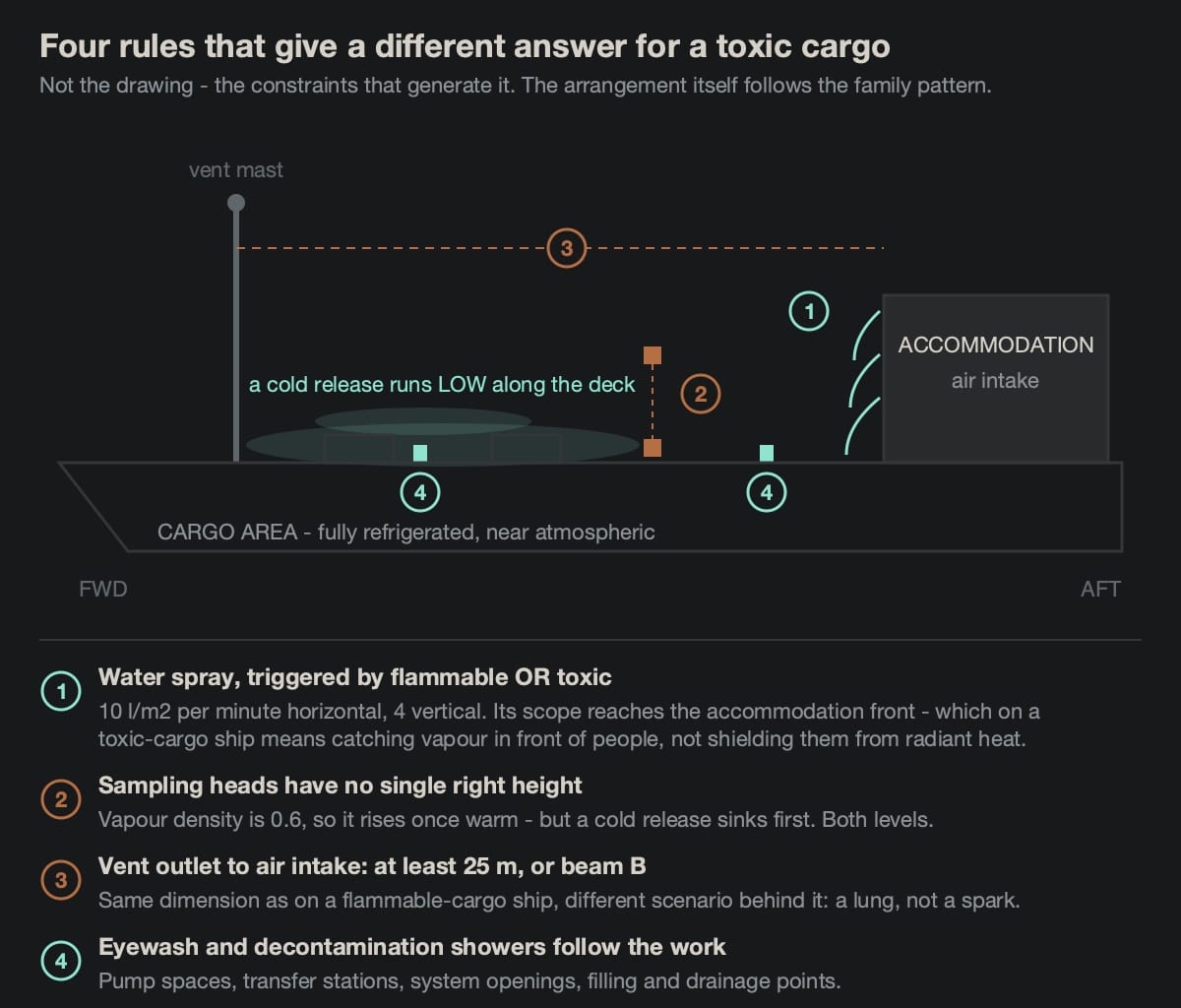
What can be established is the set of rules that governs that arrangement — and those rules produce different answers for ammonia. The four below are not the drawing; they are the constraints that generate it.
Rule one — the trigger for water spray is "flammable or toxic". What IGC 11.3 has to cover is already transcribed in the family guide. What matters here is not the list but the trigger. The clause requires the system on ships carrying flammable or toxic products, or both. It is not a clause about fire. And the fact that its scope includes the boundaries of superstructures and deckhouses facing the cargo area means something different when the cargo is toxic. The application rates are 10 l/m² per minute on horizontal projected surfaces and 4 l/m² per minute on vertical surfaces VERIFIED.
On a flammable-cargo ship, spraying the front of the accommodation is radiant-heat shielding. On a toxic-cargo ship the same spray is a wall of water in front of the space where people are, put there to catch vapour. Same pipework, same nozzles, different purpose. And when the purpose differs, so does the moment you start it: not when there is a fire, but when a leak is detected.
Rule two — there is no single right height for a sampling head. IGC 13.6's instruction and the density inversion of section 2 collide directly. The only workable answer is sampling at both levels. That conclusion comes from the physics, not from a clause.
Rule three — the distance between a vent outlet and an opening people breathe through. MSC.1/Circ.1687 6.7.2.7 places the outlet from pressure relief valves at least B (greatest moulded breadth) or 25 m, whichever is less, from the nearest air intake, air outlet or opening to accommodation, service and control spaces VERIFIED. That is a fuel-side instrument; the equivalent separation for ammonia carried as cargo was not confirmed at clause level and is taken here as class practice TYPICAL. On a flammable-cargo ship that separation exists to keep vapour away from ignition sources. On a toxic-cargo ship the destination of concern is a person's lungs. The dimension may be the same; the scenario justifying it is not, and neither are the conditions under which venting is an option at all. In fact ammonia vapour cannot be released freely to atmosphere the way a flammable boil-off can; it has to be recovered or treated.
Rule four — the emergency fittings on deck follow the work. The number and position of eyewash stations and decontamination safety showers are derived from the detailed installation arrangement, but as a minimum they belong at cargo-handling and pump locations, at transfer stations, and at points of exposure risk — system openings, filling and drainage points, and components that need periodic maintenance. The deck becomes a hazard map drawn for skin and eyes. A propane carrier's deck carries no map of that kind.
One more layer sits just above the horizon. The fuel-side rules have formalised the idea of a safe haven: an acknowledgement that a large toxic release may exceed the capacity of the mitigation systems, and a provision for one or more enclosed spaces with a cumulative capacity to accommodate all persons on board, designed to minimise exposure by means such as ventilation arrangements or a self-sustaining air supply (MSC.1/Circ.1687 12bis.5) VERIFIED. That provision currently sits in non-mandatory guidance for ammonia-fuelled ships, not in the cargo regime. But the physical scenario is the same one, which makes it a plausible migration — and worth flagging as a thing to watch rather than a thing to claim.
4. The equipment that identifies this ship
⚠ A caution before the table. The reference taxonomy contains no system data at vessel-type level; applicability relations attach systems to families, never to types. Copying the family's standard system list onto this vessel type would be invention. Every row below comes from a research source, and anything that could not be sourced is simply absent. A short list is an honest result.
| Equipment | Why this ship has it | Source · evidence |
|---|---|---|
| Cargo system with copper, copper alloys, zinc and mercury excluded | Ammonia corrodes these metals, faster in the presence of moisture | IGC chapter 17 special requirements (index confirmed) · TYPICAL |
| Post-weld heat-treated containment, piping and reliquefaction condensate parts | Anhydrous ammonia causes stress corrosion cracking in carbon-manganese steel | IGC 17.12.2–17.12.4, clause text confirmed · VERIFIED |
| Deepwell cargo pumps; submerged pump motors with copper-free windings | Ammonia is electrically conductive and attacks copper windings and insulation. Canned-stator designs are used | DNV 2024-10 (deepwell, copper-free windings) VERIFIED / canned construction, technical literature TYPICAL |
| Electrochemical ammonia detection channel plus a C₃/NH₃ selector switch | The ppm band has to be watched, and a ship that carries both must watch both atmospheres. Cross-sensitivity then has to be verified | UK P&I 2025-11 · VERIFIED (sensor technology TYPICAL) |
| Nitrogen generator — combustion-type inert gas is not usable | CO₂ reacts with ammonia to form solid ammonium carbamate, which blocks lines and valves | Chemical and shipping technical literature · TYPICAL |
| Water spray and water curtain operated for detoxification | Water absorbs ammonia and lowers its vapour pressure. Suppressing dispersion comes before cooling | IGC 11.3 clause text plus gas-carrier safety literature · VERIFIED / TYPICAL |
| EEBDs or chemical escape hoods for every person on board; eyewash and decontamination showers; at least two portable ammonia detectors | Exposure arrives before fire, and evacuation before firefighting | IGC 14.2 / 14.4 clause text; UK P&I 2026-02 · VERIFIED |
Two things should be read out of that table.
First, five of the seven rows protect people or metal, not cargo. The equipment that moves the cargo — pumps, compressors, reliquefaction — does the same job it does on an LPG carrier; what changes is materials and windings. Ammonia capability does not demand an entirely new class of machine, and that fact turns into the economics of section 5.
Second, reliquefaction does not by itself identify this ship. Direct-cycle reliquefaction is the common arrangement across gas carriers handling LPG and anhydrous ammonia alike; what changes is that the condensate side becomes subject to post-weld heat treatment. How a reliquefaction plant actually works belongs to a system article, so it is not opened here. How a state becomes a number is already covered in radar cargo tank level gauging.
5. What the difference costs
The reason this ship exists as a separate type is not safety. It is density.
Liquid ammonia has a specific gravity of about 0.68; LPG is about 0.61. Fill a hull and tanks designed around LPG density with ammonia and the weight runs out before the volume does. That is why a VLGC can be filled only to 80–85 % of its capacity with ammonia, while a VLAC — with strengthened hull and tank structure — sails with 98 % of its capacity filled (Drewry, March 2024).
One substitution makes the constraint concrete. A published specification for an 88,000 m³ VLGC — the LPG/ammonia carrier Energia Grandeur — gives a length overall of 230 m and a deadweight of 56,192 t (Baird Maritime vessel review, April 2026). Fill 88,000 m³ with ammonia to 98 % and the cargo alone weighs about 58,600 t — already past the deadweight, before bunkers, fresh water or stores. So 80–85 % is not a convention; it is a number set by buoyancy. INFERRED — the calculation follows directly from two published figures, but any particular ship's actual loading limit is set by its own trim and strength calculations.
The cost also shows up in money. A VLAC newbuilding carries a premium of USD 4–6 million over a VLGC, and converting an existing VLGC to ammonia capability costs an average of USD 2 million (Drewry, March 2024). DNV put the cost of the ammonia-capability outfit itself — deepwell pumps, copper-free submerged pump windings, additional ventilation, vapour detection — at USD 1–1.5 million per ship, around 1 % of construction cost (October 2024). For scale, a 93,000 m³ LPG carrier cost roughly USD 125 million to build at that time, up from USD 75 million in 2020.
Line the three figures up and the direction is visible. The ammonia outfit is about 1 % of build cost; the premium for the VLAC hull form amounts to 3–5 %. Whether the second figure already contains the first is not stated by the sources — and the premium probably does absorb it — so no structural unit cost is derived by subtraction here INFERRED. The conclusion that survives is still clear enough. In the decision to build this as a separate type, the heavy factor is not the hazard. It is the weight.
Behind that calculation sits a market. World ammonia production was around 190 million tonnes in 2023, but only 15–20 million tonnes move by sea; most of it is consumed near where it is made. About 198 terminals worldwide can handle ammonia as a cargo, with 9.6 million m³ of combined capacity (Drewry, March 2024). And decisively, most of that seaborne volume is carried by medium gas carriers, not by VLACs. The same study found 30 % of the existing LPG fleet and 53 % of the orderbook ammonia-capable, with the VLGC segment at 10 % of the fleet and 54 % of the orderbook.
So the VLAC is a bet on a cargo that does not exist yet in that volume. If low-carbon ammonia trade arrives as forecast, these ships are exactly the right size; if it does not, they carry LPG. Most of the VLACs ordered in 2024 were expected to be deployed initially as LPG carriers. A vessel type is being ordered in a form that hedges two futures at once — the strangest commercial property this type currently has.
The routes are not stable either. The world's longest ammonia pipeline, the Togliatti–Odesa line (about 2,470 km, up to 2.5 million tonnes a year), has been closed since February 2022; its loss was estimated at the time to cut global seaborne ammonia shipments by around 15 % (Kpler, March 2022). The leading exporters are Saudi Arabia, Indonesia and the United States; demand is led by China at about 40 % of the global total, with India next (Drewry, March 2024). The fleet and the cargo are being created at different speeds.
Part III — Operating It
6. Where the voyage cycle differs
The family guide already walked through drying, inerting, gassing up, cooling down, loading, the laden voyage, discharge, gas freeing and grade change. That order is the same here. Five points differ.
One — combustion-type inert gas cannot be used. A conventional inert gas generator produces its output by cleaning combustion exhaust, and CO₂ remains in it. CO₂ reacts with ammonia to form ammonium carbamate, which is solid at ambient temperature and pressure and settles out to block lines and valves. Inerting an ammonia system is therefore done with nitrogen. Where the family guide listed "IG generator or N₂ generator" as parallel options, this ship has no choice to make. There is one.
Two — the heat that gets in produces a different amount of vapour. Ammonia's latent heat of vaporisation at its boiling point is about 1,371 kJ/kg; propane's is about 428 kJ/kg. A factor of 3.2. The same quantity of heat entering the tank is absorbed by roughly a third as much evaporation. On top of that, ammonia's carriage temperature (−33 °C) is nine degrees warmer than propane's (−42 °C), so the temperature difference driving heat inward is smaller too. Both effects push the same way, so it is reasonable to expect less boil-off from an ammonia cargo than from propane in a tank of the same size INFERRED — the latent heats and boiling points are confirmed values, but a real ship's boil-off rate is set by its insulation specification and voyage conditions, and no published direct comparison was found.
Three — grade change is among the hardest in this family. Coming out of ammonia into propane, a residual ammonia limit of 2 ppm in the tank is quoted TYPICAL — the figure comes from operating literature and varies with cargo and charter. The difficulty is in reaching it. Ammonia dissolves in water, so a fine water spray is effective; on older ships ammonia soaks into the porosity of the tank surface and takes a long time to draw back out. But using water produces ammonium hydroxide, a caustic solution, which is why this operation is treated as one requiring supervision by an officer who has done it before. If the family guide's line was that grade change is a routine operation, the footnote this ship attaches to it reads: except in the direction that leads out of ammonia.
Four — the transfer is not over when the transfer is over. After an ammonia transfer, hot gassing and a nitrogen purge drive residual ammonia out of the transfer lines, and the concentration is verified before the hoses are disconnected. On a flammable cargo, line clearing exists to recover cargo and remove flammable material; here it exists to remove a toxic residue that would otherwise be released next to a person at the moment of disconnection. And because ammonia vapour cannot be freely vented, "blow the rest away" is not on the menu.
Five — dual-grade trading generates work of its own. A large share of this type alternates between ammonia and propane, sometimes carrying both. The reported requirements are specific: because the integrity of system segregation is the safety case, valves are pressure-tested before loading; interconnecting equipment such as cargo vaporisers and heaters is blanked off; fixed gas detection must cover both C₃ and NH₃ atmospheres, usually through a selector switch, with cross-sensitivity verified; senior officers are expected to have handled both cargoes; and additional EEBDs are carried. The bare fact that one ship divides its life between two cargoes creates a body of work that appears on no system list.
There is a recent demonstration of all five running together. In September 2024, at Western Anchorage WA19 off Dampier in Western Australia — roughly 20 nautical miles offshore — Green Pioneer and Navigator Global completed the world's first ship-to-ship transfer of ammonia at anchorage, moving 2,700 tonnes of liquid ammonia at 700–800 m³/h. The measures applied read like the list above: personal ammonia detectors for watchkeepers, portable gas-imaging devices, predefined exclusion zones on deck, nitrogen leak testing before transfer, a closed-loop vapour return during it, hot gassing and nitrogen purging afterwards, and a concentration check before disconnection. Nothing there was invented. It is the logic of a toxic cargo followed to the end.
[CHAIN 2] What this ship adds to the cycle

family stage      |  what changes here
------------------+--------------------------------------------------------
inerting          |  combustion-type IG unusable (CO2 + NH3 -> solid carbamate)
                  |  --> nitrogen only. the option list shrinks to one
loading / voyage  |  latent heat x3.2, and 9 degC less driving temperature
                  |  --> less vapour for the same heat ingress (INFERRED)
end of transfer   |  hot gassing + nitrogen purge -> concentration check
                  |  --> venting is not an available ending
grade change      |  NH3 -> C3 down to 2 ppm. water wash, then NH4OH to handle
                  |  --> the hardest direction in this family
dual-grade trade  |  valve pressure tests / blanking / detection selector
                  |  --> a body of work on no system list
7. The hazard profile shift
This is where the article's payload sits. When the leading hazard moves from flammability to toxicity, five things change in sequence.
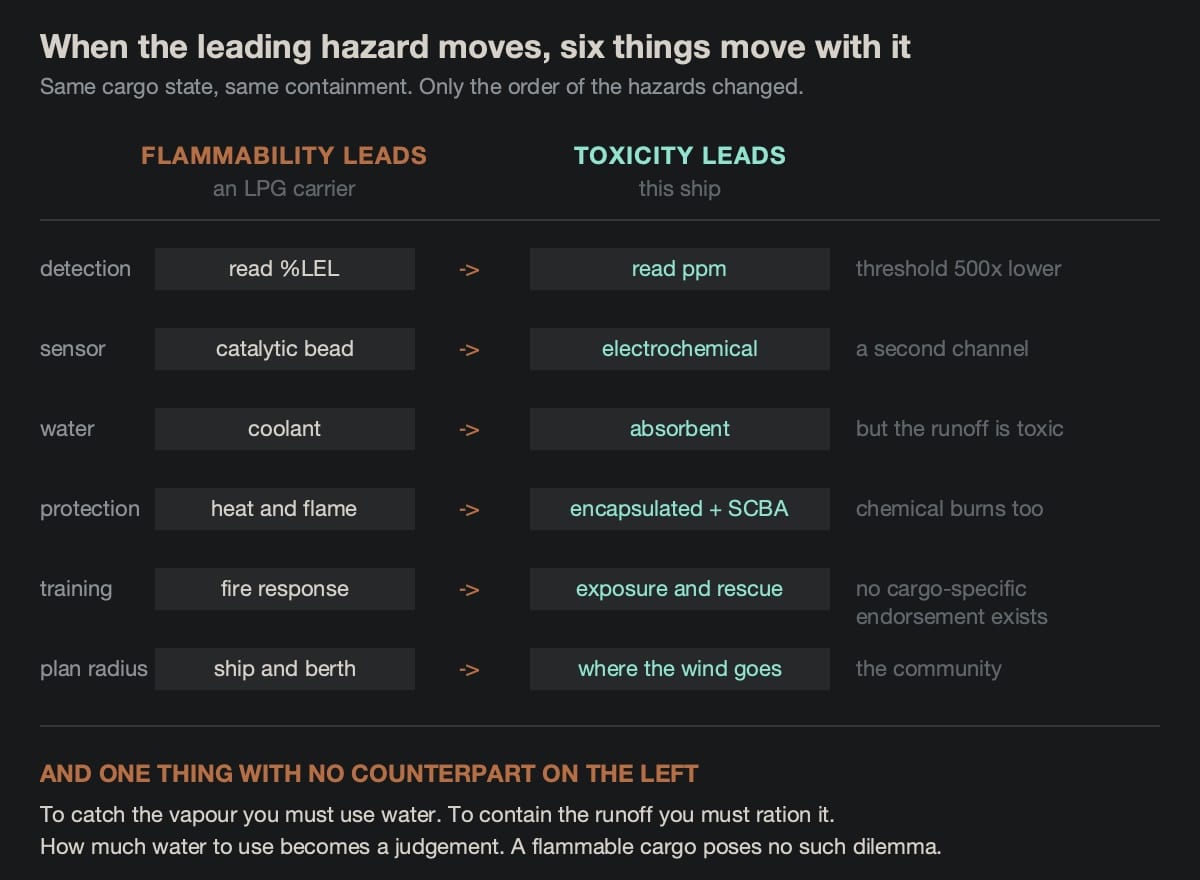
Detection — the scale changes. Fixed detection for a flammable cargo reads %LEL. A toxic cargo is read in ppm. The two axes are not read by the same instrument: electrochemical sensors are the standard for ammonia in the ppm band, while catalytic-bead elements belong to the %LEL band. That is why a dual-grade ship ends up with two channels joined by a selector switch and a cross-sensitivity check. The threshold scheme is built differently too. The threshold scheme used in the 2024 ship-to-ship pilot was alarms at 25 ppm for enclosed spaces and 110 ppm for secondary containment, 220 ppm to initiate shutdowns, and escalation to full emergency response at 250 ppm VERIFIED — and the operator records that this aligned with the then-draft IMO interim guidelines for ammonia-fuelled ships. The published instrument carries the same two middle numbers: table 1 of MSC.1/Circ.1687 sets an audible and visible alarm at 110 ppm and activation of the safety system at 220 ppm, and requires the dispersion analysis to show that 220 ppm does not reach air intakes, accommodation, machinery spaces or control stations VERIFIED. Every one of those numbers sits below the IDLH of 300 ppm. On the flammability axis they are nothing at all — 250 ppm is one six-hundredth of the lower flammable limit.
| Axis | First alarm | Stop work | Life-threatening |
|---|---|---|---|
| Flammability (vol%) TYPICAL | typically 10–30 % of LEL = 1.5–4.5 vol% | as above | on explosion |
| Toxicity (ppm) | 25 ppm (110 ppm in secondary containment) | 220 ppm (shutdown) | 300 ppm (IDLH) |
| On one scale | 15,000–45,000 ppm | 220 ppm | 300 ppm |
Firefighting — water becomes an absorbent, and a contradiction opens up. This is the most important passage in the section.
Water absorbs ammonia extremely well. Fire-service water curtains are reported to reduce ammonia concentration behind them by a factor of ten at about 13 m and a factor of three at about 20 m TYPICAL. So water spray becomes a means of knocking a vapour cloud down and steering a plume.
Three qualifications come with it.
First, do not put water directly onto a pool of liquid ammonia. Water is far warmer than liquid ammonia at −33 °C. Pouring it on adds heat, evaporation accelerates, and more vapour is produced, not less. Water is used from downwind, and it is aimed at vapour, not at liquid.
Second, the product of that absorption, ammonium hydroxide, is alkaline and corrosive. Catching the release leaves a corrosive liquid on deck and on equipment.
Third, and decisively, ammonia-contaminated water is acutely toxic to aquatic ecosystems. Water arising from firefighting or vapour suppression has to be contained and recovered, and must not be allowed into storm drains or the sea. Which is why emergency guidance instructs responders to avoid unnecessary use of water in order to limit toxic runoff.
Set the three side by side and the response principle can be seen arguing with itself. To catch the vapour you must use water; to contain the runoff you must ration it. A flammable cargo poses no such dilemma — more water is almost always better. With a toxic cargo, how much water to use becomes a judgement. That is the deepest reason why fire drills on this ship are not the fire drills of an LPG carrier.
Protection — against inhalation and contact, not flame. The grading follows concentration. Below 25 ppm (TWA), a full-face respirator. Between 25 and 300 ppm — from the short-term limit to IDLH — a chemical splash suit with SCBA, or a full-face respirator with ammonia-rated filters. Above 300 ppm (IDLH), a fully encapsulated chemical-resistant suit with SCBA, and the encapsulation is there to prevent chemical burns as well as inhalation: liquid ammonia is severely corrosive to skin, eyes and mucous membranes and causes frostbite at the same time. Added to that are EEBDs or chemical escape hoods for every crew member, eyewash stations and decontamination showers, and at least two sets of portable ammonia detectors. IGC 14.4 requires suitable respiratory and eye protection for emergency escape for every person on board for the products it applies to, and 14.2 requires not less than two complete sets of safety equipment in addition to the firefighters' outfits. Eye irrigation runs for at least fifteen minutes continuously; skin is flushed with lukewarm water for at least fifteen minutes — never hot water.
Training — the line the regulation has not yet drawn. As the family guide pointed out, the STCW liquefied gas tanker endorsement has no cargo-specific sub-endorsement. Rather than repeat that, look at what happened next. On the fuel side, the line was drawn. Ships using ammonia as fuel are steered to the STCW A-V/3 framework, whose advanced tier requires, beyond an approved course, at least one month of approved seagoing service on ships subject to the IGF Code and a minimum of three bunkering operations of fuels covered by that code, two of which may be replaced by approved simulator training VERIFIED. Note what that is and is not: the three operations are counted for IGF-Code fuels in general, not for ammonia in particular. The ammonia-specific hook is one sentence in MSC.1/Circ.1687 19.2.2, which asks that crews be qualified under STCW "taking into account the specific hazards of ammonia" VERIFIED. In other words: for a substance that has moved by sea in bulk for decades, it is the side that has only just begun burning it that first wrote the word "ammonia" into a competence requirement — and even there only as a qualifier. On the cargo side, the gap is filled by company procedures, terminal requirements and inspection and vetting regimes. When operating literature asks that senior officers on a dual-grade ship have handled both cargoes, that is practice filling a gap, not a rule being followed.
Radius — the hazard does not stop at the ship's side. An ammonia release can extend beyond the vessel, and in port it can reach the surrounding community. Emergency planning therefore uses public exposure guidelines such as the ERPG values to set evacuation zones, runs dispersion modelling, and includes communication protocols with port authorities and emergency services. If the contingency plan for a flammable cargo addresses the ship and the berth, the plan for a toxic cargo addresses wherever the wind goes.
Finally, what this looks like when it reaches people. On 6 April 2021 the 28-year-old LPG tanker Hamburg DW, on passage from Oman to China, suffered an ammonia leak while at anchor off Port Klang, Malaysia. One 62-year-old crew member died and three were left in critical condition. The detail worth holding is that no cargo transfer was under way. The ship was stationary. It was not the archetypal flammability scenario — mid-transfer, at the manifold, with an ignition source. The hazard of a toxic cargo does not stop when the work stops.
[CHAIN 3] The domino of a shifted lead hazard

when flammability leads              when toxicity leads
----------------------               --------------------------------
read %LEL                      -->   read ppm (threshold ~500x lower)
a catalytic-bead channel does  -->   a separate electrochemical channel is needed
water = coolant, more is safer -->   water = absorbent, but becomes toxic effluent
                                     --> never onto the liquid pool
                                     --> the quantity becomes a judgement
protection = heat and flame    -->   protection = encapsulation + SCBA
training = fire response       -->   training = exposure, rescue, decontamination
plan radius = ship and berth   -->   plan radius = wherever the wind goes
the event ends at ignition     -->   the event continues until it disperses
Part IV — Governance & Orientation
8. What governs this type specifically
The family guide asked of the IGC Certificate of Fitness: what kind of document is this? This article puts a different question to the same code. What did this code write for one cargo alone?
The answer is IGC 17.12, a clause whose title is simply Ammonia. The existence of a clause named after a single product says a good deal about where this cargo sits.
17.12.1 states the premise: anhydrous ammonia may cause stress corrosion cracking in containment and process systems made of carbon-manganese steel or nickel steel, and the measures in 17.12.2 to 17.12.8 shall be taken as appropriate.
17.12.2 is the substance. Tanks and piping made of carbon-manganese steel must use fine-grained material with a specified minimum yield strength not exceeding 355 N/mm² and an actual yield strength not exceeding 440 N/mm². On top of that, one of four options must be chosen:
- use a lower-strength material with a tensile strength not exceeding 410 N/mm²; or
- apply post-weld stress relief heat treatment; or
- maintain the carriage temperature at the boiling point (−33 °C) and in no case above −20 °C; or
- carry ammonia containing not less than 0.1 % w/w water, and document it.
How to read those four branches matters more than the numbers. This is not a list of equipment; it is a list of alternatives, and one of them is a question of material, one of fabrication, one of operation and one of the composition of the cargo itself. The IGC Code has distributed responsibility for a single cracking risk across the designer, the shipyard, the deck officer and the shipper, and says that satisfying any one of them is enough. Clauses shaped like that are not common in gas carrier regulation.
The rest extends the same logic. 17.12.3 requires post-weld stress relief for higher-yield carbon-manganese steels. 17.12.4 requires it for the condensate parts of the refrigeration system — which is to say that condensed ammonia carries a hazard of its own. 17.12.5 asks that welding consumables exceed the parent material's tensile and yield properties by the smallest practicable margin. 17.12.6 prohibits nickel steel with more than 5 % nickel, and carbon-manganese steels that do not comply. 17.12.8 sets a dissolved oxygen level of below 2.5 ppm w/w, with a table of permitted oxygen percentages by carriage temperature.
One gap between the clause and the trade is worth naming. Industry literature commonly quotes 0.2 % water as the inhibitor level; the clause says not less than 0.1 % w/w. The two are not contradictory so much as a floor and a practice — but which one you quote tells you which document you have been reading, so both belong here. And there is a subtler point. Inhibiting the liquid phase with water does not inhibit the condensed vapour phase: ammonia that has evaporated and condensed again contains far less inhibiting water and relatively more oxygen. That is the most natural reading of why 17.12.4 singles out the condensate side INFERRED.
What attaches to this cargo outside 17.12 has already appeared above — the materials restriction excluding mercury, copper and copper-bearing alloys and zinc, personal protection under 14.4, and water spray under 11.3. Secondary literature is consistent that the anhydrous ammonia row of the chapter 19 table sets the IGC ship type and invokes 14.4, 17.2.1 and 17.12 in its special-requirements column, but the column letters and the exact entries in that row were not confirmed against the code text. They are left at TYPICAL — and accordingly this article does not assert this ship's tank type or class on the strength of the chapter 19 table. The exact wording of 17.2.1 was likewise not confirmed.
One last inversion in the sequence of regulation. Ammonia has moved by sea in bulk for decades, yet the recent IMO instrument that set out a goal- and function-based treatment of its toxicity came from the fuel side, not the cargo side. MSC.1/Circ.1687, Interim Guidelines for the Safety of Ships Using Ammonia as Fuel, was circulated on 26 February 2025 — non-mandatory guidance refined at CCC 10 (September 2024) and approved at MSC 109 (December 2024). The safe haven concept, the exposure criteria and the crew protection provisions live there. It was not the layer that has carried this cargo for decades that organised the language first, but the layer that has only just begun to burn it. Whether the cargo side takes that language back is still open.
9. Among its siblings
| ID | Vessel type | Korean | That sibling's line | How this ship differs |
|---|---|---|---|---|
| ST-011 | LPG Carrier | LPG운반선 | Propane and butane, pressurised or refrigerated — the containment choice decides whether a reliquefaction plant exists at all | Identical containment, different leading hazard: flammability there, toxicity here |
| ST-012 | Ethylene Carrier | 에틸렌운반선 | Semi-refrigerated at −104 °C; reliquefaction is mandatory | One ship's problem is temperature, this one's is toxicity. −33 °C is enough here |
| ST-013 | Ethane Carrier (VLEC) | 에탄운반선 | Very large, typically dual-fuel burning its own cargo | Ammonia is not a hydrocarbon and cannot be burned in those same dual-fuel engines |
| ST-015 | CO₂ Carrier | CO2운반선 | Liquefied CO₂ for CCS chains; regulation still developing | Put the two cargoes together and you get solid carbamate — the reason this ship cannot use combustion-type inert gas |
| ST-016 | Liquefied Hydrogen Carrier | 액화수소운반선 | −253 °C in vacuum-insulated tanks; demonstration stage | There the problem is holding the cargo in; here the problem is the cargo that has got out |
| ST-062 | LNG / Gas Bunkering Vessel | LNG·가스 벙커링선 | Transfers gas fuel to receiving ships; vapour return and custody transfer are the interface | Ammonia bunkering adds a toxic radius to that same interface |
10. Where to go next
This article leans on the layer above it and the layer below it.
Above — the family guide. The physics of the cargo, the skeleton of the IGC regime, Type A and Type C containment, general arrangement patterns, the ten stages of the voyage cycle, the terminal interface with ESD1 and ESD2, and the character of the Certificate of Fitness are all in the LPG and gas carrier family guide. Everything this article handed off with "the family guide covered that" is there. (That guide is currently a draft.)
Below — the system articles. How a state becomes a number is already covered in radar cargo tank level gauging. Three doors are left open here and deliberately not entered:
- Cargo compressors and reliquefaction — this article goes no further than noting that the condensate side becomes a post-weld heat treatment item.
- Gas detection — how a ppm axis and a %LEL axis are made to coexist on one ship.
- Water spray and deluge — how nozzle selection, flow and start logic differ when the fluid is being used as an absorbent rather than a coolant.
Beside — the siblings. The table in section 9 is a map, not a summary.
There is also a direction this type is moving in. The first two-stroke ammonia dual-fuel main engine is scheduled for delivery to a very large ammonia carrier, and the world's first ammonia dual-fuel gas carrier, the 46,000 m³ MGC Antwerpen, was delivered in June 2026. The ship that carries this cargo is beginning to burn it, which folds the fuel-side regime described in section 8 back onto the cargo-side ship. That is a subject for its own article.
The short version
- The order changes not because ammonia will not burn, but because toxicity arrives first. The lower flammable limit is 150,000 ppm and the IDLH is 300 ppm. The gap between those two scales is the design logic of this ship.
- The role of water is inverted. It is an absorbent, not a coolant — and because the water that absorbs becomes toxic effluent, how much to use becomes a judgement. A flammable cargo poses no such dilemma.
- The IGC Code wrote a clause for this one cargo. 17.12 splits a single cracking risk across material, fabrication, operation and cargo composition, and lets you satisfy any one of them.
- What created this vessel type is density, not hazard. 0.68 against 0.61 is the difference between an 80–85 % fill and a 98 % fill, and the structural premium is several times the safety outfit.
- The fleet is being built ahead of the cargo. Most seaborne ammonia still moves in medium gas carriers; the VLAC is a bet on volume that has not arrived.
[FINAL CHAIN]

fully refrigerated ammonia = the same containment as an LPG carrier
        |
        +--> but the leading hazard differs (toxic 300 ppm vs flammable 150,000 ppm)
                |
   +------------+------------+------------+------------+
   |            |            |            |            |
detection    role of      grade of     training     radius of
scale        water        protection   and rules    the plan
add a ppm    absorbent    encapsulated practice     wherever
axis         (+ effluent) + SCBA       fills a gap  the wind goes
   |            |            |            |            |
   +------------+------------+------------+------------+
                             |
        and because the cargo eats the steel, IGC 17.12 exists on its own
                             |
        + density 0.68 strengthened the hull and produced the VLAC
Sources
- Reference taxonomy shipType record ST-014 — review status: reference taxonomy, no vessel verification performed
- IGC Code 17.12 Ammonia (17.12.1–17.12.8), 14.2, 14.4, 11.3 and 13.6 — clause text confirmed
- IGC Code chapter 19 anhydrous ammonia row and 17.2.1 — secondary literature only, code text not confirmed
- MSC.1/Circ.1687, Interim Guidelines for the Safety of Ships Using Ammonia as Fuel, 26 February 2025 — 6.7.2.7 vent outlet separation, 12bis.5 safe haven, 15.8.8 and table 1 alarm and shutdown thresholds, 19.2.2 training; annex text confirmed
- STCW Code section A-V/3, advanced training for service on ships subject to the IGF Code — seagoing service and bunkering-operation requirements
- Drewry, Ammonia shipborne trade: navigating the bubble for sustainable growth, March 2024 — fill limits, newbuilding premium, trade volume, terminal count, ammonia-capable fleet shares
- DNV, Investing in future ammonia markets, October 2024 — specific gravity comparison, ammonia-capability outfitting cost, ordering activity
- UK P&I, Risk Focus: Ammonia Bunkering and Handling, February 2026 — physical properties, exposure limits, PPE grading, first aid, emergency response, environmental handling, fuel-side training framework
- UK P&I, Expanding gas trades: perspective on LPG, ethane and ammonia carriage, November 2025 — dual-grade operating practice
- GCMD, ship-to-ship ammonia transfer pilot at Western Anchorage WA19, Port of Dampier, 14 September 2024 — world first at anchorage; procedure, quantities and threshold values
- Baird Maritime, vessel review of the 88,000 m³ LPG/ammonia carrier Energia Grandeur, 6 April 2026 — principal dimensions and deadweight
- Kpler, Seaborne ammonia shipments poised for a 15% cut, March 2022 — effect of the Togliatti–Odesa pipeline closure
- Water-curtain effectiveness against accidental ammonia release — Journal of Loss Prevention in the Process Industries (French fire-service trials)
- The Maritime Executive, Hamburg DW ammonia leak report, 7 April 2021
- Lloyd's Register press release, delivery of MGC Antwerpen, 10 June 2026
- Physical property values (latent heat, specific gravity, flammable range, autoignition temperature) — public property databases
- Stress corrosion cracking literature — National Board, Fertilizers Europe
Article Classification
- Class: Engineering Intelligence — vessel type profile
- Evidence profile: one sentence of reference taxonomy plus public technical, regulatory and commercial literature. No vessel verification was performed, so the default grade is TYPICAL. Only clauses confirmed against the instrument text (IGC 17.12, 14.2, 14.4, 11.3, 13.6; MSC.1/Circ.1687 6.7.2.7, 12bis.5, 15.8.8, table 1, 19.2.2; STCW A-V/3) and statistics traced to a named source and year are graded VERIFIED. The chapter 19 column letters and the wording of 17.2.1 were not confirmed. This article was re-checked against primary sources by an independent pass on 12 September 2026; the corrections it forced are recorded in the project file
- Scope: Vessel-type reference profile. Applicability to a particular ship, project or contract is not verified. Fleet, orderbook and cost figures are as of the years cited, and this segment moves quickly
- ⚠ No vessel-type system data exists in the reference taxonomy — applicability relations reference vessel types zero times. The equipment list in section 4 rests entirely on research sources and was not derived from the family's standard system list