
On this page
The Trump administration’s ambitious plan to rebuild American shipbuilding capabilities confronts the stark reality of China’s overwhelming dominance in global maritime industries. With the April 2025 executive order and unexpected international partnerships, the US is mounting its most comprehensive maritime revival effort in decades — but the challenge is immense.
President Trump’s “Restoring America’s Maritime Dominance” executive order, signed April 9, 2025, launches a government-wide campaign to revitalize an industry that has withered to less than 1% of global commercial shipbuilding capacity. The 15-page executive order establishes a Maritime Action Plan framework with specific timelines spanning 210 days and assigns tasks across multiple federal agencies, while the current US fleet has shrunk from over 1,200 vessels in 1951 to fewer than 180 today — an 85% reduction that mirrors America’s broader industrial decline.
This maritime revival comes as China produces approximately 1,700 ships annually compared to America’s fewer than five, creating what experts describe as a national security crisis decades in the making. The initiatives represent more than economic policy — they’re a strategic response to China’s systematic capture of global maritime infrastructure, from shipbuilding to port operations, that threatens American economic security and naval supremacy.
China’s stranglehold on global shipping reveals strategic vulnerabilities
The scale of China’s maritime dominance is staggering and extends far beyond simple market share statistics. China now controls 70–71% of global new ship orders in 2024, up from just 5% in 2000, while simultaneously building the world’s largest naval fleet. This dual-use strategy enables Beijing to leverage commercial shipbuilding capacity for military purposes, with Chinese Tier 1 shipyards serving both commercial and military production.
The infrastructure dependencies are equally concerning. China builds 96% of the world’s containers while America builds zero, and Chinese companies manufacture 80% of ship-to-shore cranes compared to America’s 0% domestic production. Chinese state-owned software operates in US port facilities with limited alternatives available, creating cybersecurity vulnerabilities that extend throughout America’s supply chain infrastructure.
Seven of the top 10 global shipbuilders are Chinese companies, led by China State Shipbuilding Corporation which commands 23% of the global market alone. This concentration enables China to offer state-subsidized pricing that private competitors cannot match, while simultaneously advancing military capabilities through technology transfer and dual-use manufacturing capacity.
The strategic implications extend beyond economics. China’s People’s Liberation Army Navy is projected to operate 435 ships by 2030 compared to the US Navy’s expected 291 vessels, representing a fundamental shift in global naval power. As Alexander Palmer from the Center for Strategic and International Studies notes, “The U.S. Navy faces a growing possibility of defeat at sea for the first time in half a century.”
The MASGA surprise: South Korea proposes massive shipbuilding investment
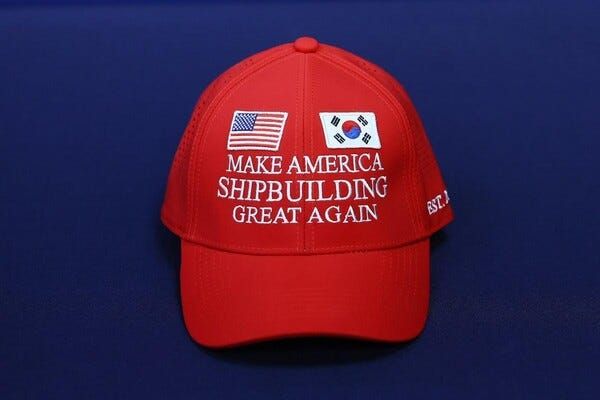
Perhaps the most intriguing development in America’s maritime revival involves the Make American Shipbuilding Great Again (MASGA) initiative — which is actually a $150 billion South Korean proposal to invest in US shipbuilding capacity. This unexpected international partnership emerged from bilateral trade negotiations between Seoul and the Trump administration, designed to help South Korea avoid 25% tariffs while supporting American industrial revival.
MASGA represents part of a larger $350 billion South Korean investment package in the United States, with major Korean shipbuilders including HD Hyundai, Hanwha Ocean, and Samsung Heavy Industries committing to establish new US shipyards and modernize existing facilities. The initiative leverages South Korea’s advanced automation and AI-driven shipbuilding technologies while creating American jobs and reducing dependence on Chinese maritime infrastructure.
Hanwha Ocean’s December 2024 acquisition of Philadelphia Shipyard signals the beginning of this strategic partnership, as Korean companies bring expertise in high-value vessels like LNG carriers, where South Korea maintains 62% global market share. The collaboration focuses on both commercial and military vessel construction, with Korean firms already securing US Navy maintenance, repair, and overhaul contracts.
The timing reflects South Korea’s strategic calculation as it faces gradual market share loss to Chinese competitors. By investing in American capacity, Korean shipbuilders gain access to the protected US defense market while helping America rebuild capabilities that have been dormant for decades. As one Korean industry official noted, “We see this as a win-win opportunity to combine Korean technology with American strategic requirements.”
Economic transformation promises hundreds of thousands of new jobs
The maritime revival initiatives target massive economic transformation across American coastal regions, with job creation potential that extends far beyond direct shipbuilding employment. The industry currently employs 107,180 direct workers generating $9.9 billion in labor income, but economic multiplier effects suggest each direct job supports approximately 4 additional positions throughout the economy.
Regional impact analysis reveals that major shipbuilding centers like Virginia’s Newport News Shipbuilding employ 24,000 workers, while Alabama’s Austal USA adds another 4,200 positions. The Navy’s Maritime Industrial Base Program anticipates requiring 250,000 new skilled workers over the next decade, representing one of the largest industrial workforce expansions in recent American history.
Maritime employment offers wages 50% higher than average private sector positions, according to Department of Transportation data, making these jobs particularly attractive for economic development. Historical analysis shows that America lost 145,000 shipbuilding jobs since 1980, which translates to 580,000 total economic positions when accounting for multiplier effects and population growth.
The regional concentration creates opportunities for targeted economic development. Top 5 states account for nearly two-thirds of private shipbuilding employment, with significant operations spanning Virginia, Alabama, Maine, Mississippi, Wisconsin, and California. Research demonstrates that shipyard workers show high geographic immobility but willingness for extended commutes, suggesting that strategic shipyard placement could revitalize entire coastal regions.
Mark A. Clements Jr. of the Maritime Trades Department, AFL-CIO, emphasizes the transformative potential: “The SHIPS for America Act is a transformative piece of legislation that will bolster the United States’ commercial competitiveness and military readiness on the high seas. Not only will this bipartisan bill protect existing jobs in maritime and allied trades, but it will lead to a renaissance of the American maritime workforce.”
Supply chain reshoring confronts decades of industrial hollowing
America’s maritime decline created supply chain vulnerabilities that extend throughout the industrial base, requiring comprehensive reshoring efforts that go beyond shipbuilding itself. Critical dependencies include specialized castings, marine equipment, and electronic systems that American manufacturers abandoned as domestic shipbuilding collapsed.
The executive order addresses these vulnerabilities through Defense Production Act Title III authorities and Office of Strategic Capital loan programs designed to rebuild domestic supplier networks. Fairbanks Morse Defense has strategically acquired 11 companies since 2020 to control critical supply chain elements, demonstrating how defense contractors are proactively addressing dependencies.
Innovation in manufacturing processes offers hope for competitive revival. Development of 3D-printed valve assemblies reduces production time by two-thirds, while advanced automation and robotics integration could help American shipyards compete on efficiency rather than labor costs alone. The robotics in shipbuilding market is projected to grow from $5.91 billion in 2023 to $25.2 billion by 2032, driven by precision requirements and safety considerations.
Supply chain restructuring extends beyond American borders. 97% of companies are reconfiguring supply chains, according to recent surveys, with increased regionalization and dual sourcing strategies becoming standard practice. This creates opportunities for allied nations like South Korea and Japan to participate in American supply chain rebuilding while reducing Chinese dependencies.
Strategic competition reshapes global maritime power dynamics
The American maritime revival occurs within a broader context of strategic competition that will reshape global power dynamics for decades. China’s 232 times larger shipbuilding capacity compared to the United States represents more than economic dominance — it enables rapid military expansion and strategic influence projection throughout global trade routes.
The Section 301 investigation findings provide legal foundation for comprehensive trade actions, including port fees up to $1.5 million per call for Chinese-built vessels and cargo preferences for US-flagged ships. These measures aim to create market signals that support domestic shipbuilding while imposing costs on Chinese maritime expansion.
International responses are already emerging. South Korea and Japan are positioning themselves as preferred partners for American maritime revival, while European shipbuilders focus on specialized segments like luxury cruise ships and high-technology vessels. The global shipbuilding industry invested $168.4 billion January-October 2024, representing 85% above the 10-year average and indicating massive capital flows into maritime capacity.
The competitive dynamics extend to technology leadership. Alternative-fueled ship orders increased 50% in 2024, with ammonia-ready LNG carriers commanding 25% price premiums. This green technology revolution creates opportunities for American and allied shipbuilders to compete on innovation rather than pure cost, potentially offsetting Chinese advantages in traditional manufacturing.
Ambassador Katherine Tai, US Trade Representative, frames the challenge starkly: “Today, the U.S. ranks 19th in the world in commercial shipbuilding, and we build less than 5 ships each year, while the PRC is building more than 1,700 ships. In 1975, the United States ranked number one, and we were building more than 70 ships a year.”
Implementation challenges test political will and industry capacity
Despite ambitious goals and broad bipartisan support, the maritime revival faces substantial implementation challenges that will test sustained political commitment. The Congressional Budget Office estimates $40 billion annually through 2054 for Navy shipbuilding alone, requiring Navy budget increases from $255 billion to $340 billion by 2054.
Current American shipbuilding capacity remains severely limited, with only two facilities capable of nuclear submarine construction and a single shipyard handling aircraft carrier work. This bottleneck means that meaningful capacity expansion requires massive infrastructure investment and workforce development that will take years to materialize.
The 210-day Maritime Action Plan timeline established by the executive order creates accountability mechanisms, but success depends on Congressional funding approval, sustained private investment, and successful international coordination. The Maritime Security Trust Fund will rely on tariff revenue, fines, and fees to provide dedicated funding, but this structure requires legislative support to implement effectively.
Workforce development presents particular challenges. Training mariners and shipyard workers requires years of specialized education, while competition for skilled labor from other industries could inflate costs. The establishment of Maritime Prosperity Zones modeled on Opportunity Zones offers regulatory relief, but their effectiveness depends on specific implementation details still being developed.
Senator Mark Kelly, co-sponsor of the SHIPS Act, acknowledges the scope: “We’ve always been a maritime nation, but the truth is we’ve lost ground to China, who now dominates international shipping and can build merchant and military ships much more quickly than we can. The SHIPS for America Act is the answer to this challenge.”
Future outlook: Decade-long struggle for maritime supremacy
The success of America’s maritime revival will ultimately be measured not in legislative victories or executive orders, but in steel hulls entering global waters flying American flags. The target increase from 0.13% to 5% of global capacity within five years represents one of the most ambitious industrial policy goals in modern American history.
Short-term indicators suggest positive momentum. Major Korean investments through MASGA provide immediate expertise and capital, while bipartisan Congressional support offers political sustainability that transcends electoral cycles. The establishment of international partnerships creates competitive alternatives to Chinese dominance while building allied maritime capabilities.
However, fundamental challenges remain formidable. Chinese state-directed investment continues at massive scale, while American private capital markets demand returns that may not align with strategic objectives. The global shipbuilding market expects $264.3 billion total investment in 2024, with China capturing the majority of these capital flows through state subsidies and guaranteed demand.
The technology competition adds another dimension to the challenge. Digital shipyard transformation, alternative fuels, and autonomous vessel development require sustained innovation investment that American companies must balance against immediate profitability pressures. Success will depend on whether American maritime revival can achieve both economic viability and strategic objectives simultaneously.
Matthew P. Funaiole from the Center for Strategic and International Studies offers cautious optimism: “An ambitious new White House executive order seeks to revitalize the U.S. maritime industry. This article unpacks the dynamics driving the push to restore U.S. shipbuilding and how these measures are tied to competition with China.”
Conclusion
America’s maritime revival represents far more than industrial policy — it’s a comprehensive response to strategic competition that will determine global power dynamics for the next century. The combination of executive action, international partnerships like MASGA, and bipartisan legislative support creates the most promising opportunity for American maritime renewal in decades.
Yet the challenge remains immense. China’s 71% market share and systematic industrial strategy built over two decades cannot be reversed quickly or easily. Success will require sustained political commitment, massive capital investment, and effective international coordination that maintains allied relationships while rebuilding American capabilities.
The stakes extend beyond economics to fundamental questions of national security and global leadership. As America learned during World War II, maritime dominance enables global influence and strategic flexibility that no other capability can replace. Whether the current maritime revival succeeds in restoring American competitiveness will shape not only trade flows and naval power, but America’s role in the world for generations to come.
The next 210 days of Maritime Action Plan development will prove crucial in translating ambitious vision into specific, funded programs. The maritime revival has begun — its ultimate success depends on execution that matches the scale of the challenge.