
On this page
Cargo Ships — The Giants of Global Trade
How massive cargo ships move 90% of the world’s goods across our oceans, and the engineering marvels that make it possible
Introduction: Navigating the World of Maritime Vessels
The world’s oceans cover more than 70% of our planet’s surface, serving as highways for an incredible diversity of vessels that have shaped human civilization for millennia. From ancient merchant galleons to modern supertankers, ships have been the backbone of exploration, trade, and cultural exchange. Today, these maritime marvels represent some of the most sophisticated engineering achievements of our time, each designed with specific purposes that reflect the complex needs of our interconnected world.
In our modern era, maritime transport moves over 90% of global trade by volume, making it the most vital component of international commerce. The ships that accomplish this feat are as diverse as the cargo they carry and the missions they fulfill. Understanding these vessels — their design principles, operational capabilities, and technological innovations — provides insight into not only maritime engineering but also the invisible infrastructure that supports our daily lives.
About This Series: A Deep Dive into Maritime Engineering
This comprehensive four-part series will take you on a journey through the fascinating world of maritime vessels, exploring the engineering principles, operational challenges, and economic forces that shape ship design. Each installment focuses on a specific category of vessels, providing detailed insights into their unique characteristics and roles in our global maritime ecosystem.
Our Maritime Vessel Series Roadmap:
Part 1: Cargo Ships — The Workhorses of Global Trade (This Article) We begin with cargo vessels, the unsung heroes that form the backbone of international commerce. From massive container ships carrying thousands of standardized boxes to specialized tankers transporting liquid commodities, we’ll explore how these engineering marvels move 11 billion tons of goods annually across the world’s oceans.
Part 2: Passenger Vessels — Connecting People Across the Seas Our second installment examines vessels designed to transport people, from luxurious cruise ships that serve as floating cities to essential ferry services that connect island communities. We’ll explore how passenger safety, comfort, and entertainment needs drive unique design solutions.
Part 3: Specialized Vessels — Purpose-Built Solutions for Unique Challenges The third part delves into highly specialized vessels including research ships advancing marine science, fishing vessels feeding global populations, offshore support vessels enabling ocean energy production, and other purpose-built craft that tackle specific maritime challenges.
Part 4: Naval and Military Vessels — Power Projection and Maritime Security Our final installment explores military vessels, from agile destroyers and frigates to massive aircraft carriers, examining how defense requirements and strategic considerations create some of the most advanced and capable ships ever built.
Why Understanding Ships Matters
Ships represent far more than mere transportation tools. They embody centuries of accumulated knowledge in naval architecture, marine engineering, and operational expertise. Each vessel type reflects careful optimization of competing demands: efficiency versus safety, capacity versus maneuverability, cost versus capability.
For professionals in logistics, international trade, or maritime industries, understanding ship capabilities and limitations is essential for making informed decisions. For curious minds fascinated by engineering and technology, ships offer compelling examples of how human ingenuity solves complex problems at massive scales.
Moreover, as global trade continues to grow and environmental concerns drive innovation in marine technology, the evolution of ship design provides insights into future trends that will shape our world’s economy and environment.
Setting Sail on Our Journey
Every day, thousands of cargo ships traverse the world’s oceans, carrying everything from your morning coffee to the smartphone in your pocket. These maritime workhorses form the invisible backbone of global commerce, moving approximately 11 billion tons of cargo annually. Without them, the interconnected world economy as we know it simply couldn’t exist.
This first installment focuses on cargo ships — the unsung heroes that keep global trade flowing 24/7, 365 days a year. We’ll explore the engineering principles that make efficient cargo transport possible, examine different types of cargo vessels and their specialized capabilities, and look toward the future of sustainable maritime freight transport.
The Scale of Maritime Cargo Transport
Before we explore specific vessel types, it’s important to understand the sheer magnitude of maritime cargo transport. According to the International Maritime Organization (IMO), ships carry over 90% of global trade by volume. This represents goods worth more than $14 trillion annually, making maritime transport the most cost-effective method for moving large quantities of goods across long distances.
The efficiency is staggering: a single large container ship can carry the equivalent cargo of thousands of trucks, while consuming significantly less fuel per ton of cargo transported.
Container Ships: The Backbone of Modern Commerce
Evolution and Design Philosophy
Container ships revolutionized global trade when they emerged in the 1950s. The standardization of shipping containers created unprecedented efficiency in cargo handling, transforming chaotic port operations into precise, mechanized processes.
The Container Revolution: The introduction of standardized containers reduced cargo handling costs by up to 90% and port turnaround times from weeks to hours. This transformation enabled the globalization of manufacturing and just-in-time supply chains that define modern commerce.
Technical Specifications and Characteristics
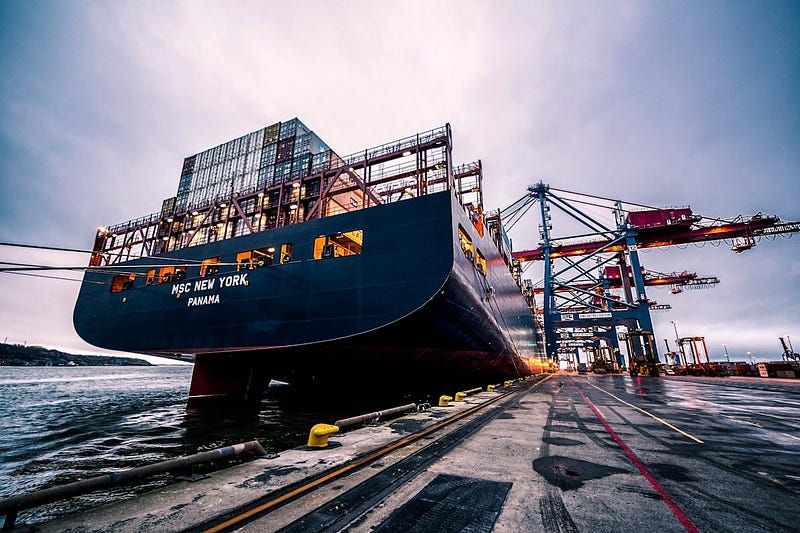
Modern container ships are marvels of engineering efficiency. The largest vessels, known as Ultra Large Container Vessels (ULCVs), can carry over 24,000 twenty-foot equivalent units (TEUs).
Key Design Features:
Cellular Construction: Container ships feature a cellular structure with vertical guide rails that ensure containers fit precisely into designated slots. This system allows for efficient loading while maintaining structural integrity during rough seas.
Minimal Superstructure: The bridge and accommodation areas are positioned to minimize interference with cargo operations. Many modern designs place the superstructure at the stern to maximize cargo capacity.
Advanced Stability Systems: Large container ships employ sophisticated ballast systems and, increasingly, active fin stabilizers to maintain stability when carrying high stacks of containers.
Propulsion and Efficiency: Modern container ships typically use large, slow-turning diesel engines optimized for fuel efficiency. The latest vessels incorporate waste heat recovery systems and advanced hull designs to minimize environmental impact.
Size Classifications and Capabilities
Container ships are classified by their carrying capacity:
Feeder Ships (Under 1,000 TEU): These smaller vessels serve regional routes and connect smaller ports to major hub terminals.
Feedermax (1,000–2,000 TEU): Designed for short-sea shipping and regional distribution networks.
Handy Size (2,000–3,000 TEU): Versatile vessels suitable for various trade routes and port restrictions.
Sub-Panamax (3,000–5,000 TEU): Sized to transit the original Panama Canal locks.
Panamax (5,000–10,000 TEU): The maximum size that could originally transit the Panama Canal.
Post-Panamax (10,000–14,500 TEU): Larger vessels that required the expanded Panama Canal.
Ultra Large Container Vessels (14,500+ TEU): The giants of container shipping, primarily serving major trade routes between Asia, Europe, and North America.
Bulk Carriers: Moving the World’s Raw Materials
The Foundation of Industrial Supply Chains
Bulk carriers transport the raw materials that fuel global industry: iron ore for steel production, coal for energy generation, grain for food security, and countless other commodities. These vessels are specifically designed to handle loose, unpackaged cargo efficiently and safely.
Design Characteristics and Innovations
Cargo Hold Configuration: Bulk carriers feature multiple cargo holds separated by strong bulkheads. This design allows for carrying different types of cargo simultaneously while maintaining structural integrity.
Loading and Unloading Systems: Many modern bulk carriers incorporate self-unloading systems, including conveyor belts and pneumatic discharge equipment. However, many still rely on port-based grab cranes and conveyor systems.
Structural Considerations: The hull structure must withstand the concentrated loads of heavy, dense cargoes like iron ore, while also handling lighter cargoes that may not fully utilize weight capacity.
Ballast Water Management: When sailing empty, bulk carriers carry ballast water to maintain stability and proper draft. Advanced ballast water treatment systems prevent the spread of invasive marine species.
Bulk Carrier Classifications
Small Bulk Carriers (10,000–35,000 DWT): Serve coastal and short-sea trades, often accessing smaller ports.
Handysize (35,000–60,000 DWT): The workhorses of bulk shipping, offering flexibility in cargo types and port access.
Supramax/Ultramax (60,000–65,000 DWT): Enhanced versions of Handysize vessels with improved efficiency and cargo handling capabilities.
Panamax (65,000–90,000 DWT): Designed to maximize cargo capacity while fitting through Panama Canal locks.
Capesize (90,000+ DWT): The largest bulk carriers, named for their need to round the Cape of Good Hope when fully loaded, as they’re too large for the Panama or Suez canals.
Tankers: Safely Transporting Liquid Commodities
Engineering for Safety and Environmental Protection
Tanker design prioritizes safety and environmental protection above all else. The transportation of crude oil, refined petroleum products, chemicals, and liquefied gases requires sophisticated engineering solutions to prevent accidents and protect marine environments.
Revolutionary Safety Features
Double Hull Construction: Following major oil spills in the 1980s and 1990s, double hull construction became mandatory for new tankers. This design provides a protective barrier between cargo and the ocean, significantly reducing the risk of spills during minor collisions or groundings.
Inert Gas Systems: Tankers carrying flammable liquids use inert gas systems to replace oxygen in cargo tanks, preventing explosions during loading, transportation, and unloading operations.
Cargo Monitoring Systems: Advanced sensors continuously monitor cargo temperature, pressure, and tank conditions, alerting crew to any anomalies that could indicate problems.
Segregated Ballast Tanks: Dedicated ballast tanks prevent contamination of ballast water with cargo residues, protecting marine environments and ensuring vessel stability.
Tanker Specializations
Crude Oil Tankers: Designed to transport unrefined petroleum from production areas to refineries worldwide.
Product Tankers: Carry refined petroleum products like gasoline, diesel, and jet fuel, often featuring multiple segregated tanks for different products.
Chemical Tankers: Specialized vessels with sophisticated tank coating systems and pumping arrangements for transporting various chemical products.
LNG Carriers: Highly specialized vessels with cryogenic storage systems for transporting liquefied natural gas at -162°C.
LPG Carriers: Transport liquefied petroleum gas, featuring pressurized or refrigerated storage systems.
Specialized Cargo Vessels
Roll-on/Roll-off (RoRo) Ships
RoRo vessels allow vehicles and wheeled cargo to be driven directly on and off the ship, eliminating the need for cranes or other lifting equipment.
Design Features:
- Multiple vehicle decks connected by ramps
- Stern and side doors for efficient loading
- Specialized ventilation systems for vehicle decks
- Flexible cargo securing systems
Heavy Lift and Project Cargo Ships
These specialized vessels transport oversized and overweight cargo that cannot fit in standard containers or bulk holds.
Capabilities:
- Cranes capable of lifting hundreds of tons
- Removable deck sections for loading large items
- Reinforced deck structures for concentrated loads
- Specialized cargo securing systems
Refrigerated Cargo Ships (Reefers)
Though containerized refrigerated transport dominates today, specialized reefer ships still serve specific trades requiring precise temperature control.
Features:
- Multiple temperature zones
- Advanced air circulation systems
- Backup refrigeration systems
- Specialized cargo handling for perishables
The Economics of Cargo Shipping
Cost Efficiency at Scale
The economics of cargo shipping are driven by scale. Larger ships generally offer lower per-unit transportation costs, which has led to the continuous growth in vessel sizes over the past decades.
Operational Considerations:
- Fuel costs represent 50–60% of operating expenses
- Port charges and canal fees favor larger vessels
- Crew costs remain relatively fixed regardless of ship size
- Maintenance costs increase with vessel complexity and size
Environmental Impact and Sustainability
The shipping industry faces increasing pressure to reduce its environmental footprint. Modern cargo ships incorporate numerous technologies to improve efficiency and reduce emissions:
Fuel Efficiency Measures:
- Optimized hull designs and propeller systems
- Weather routing to minimize fuel consumption
- Slow steaming practices during periods of low demand
- Waste heat recovery systems
Alternative Fuels:
- Liquefied natural gas (LNG) propulsion
- Methanol and ammonia fuel systems under development
- Wind-assisted propulsion technologies
- Hybrid electric systems for port operations
The Future of Cargo Shipping
Technological Innovations
The cargo shipping industry stands on the brink of revolutionary changes driven by digital technology and environmental concerns.
Digitalization:
- Internet of Things (IoT) sensors for cargo monitoring
- Artificial intelligence for route optimization
- Blockchain technology for supply chain transparency
- Predictive maintenance systems
Autonomous Shipping:
- Remote-controlled vessels for specific routes
- Fully autonomous cargo ships under development
- Enhanced safety through reduced human error
- Operational efficiency improvements
Sustainability Initiatives
The International Maritime Organization has set ambitious targets for reducing greenhouse gas emissions from shipping by at least 50% by 2050 compared to 2008 levels.
Green Technologies:
- Zero-emission fuel development
- Energy-efficient ship designs
- Port electrification for reduced emissions during cargo handling
- Circular economy principles in ship recycling
Conclusion: The Unsung Heroes of Global Commerce
Cargo ships may lack the glamour of cruise liners or the drama of naval vessels, but they are the true heroes of our interconnected world. These engineering marvels enable the global economy by moving vast quantities of goods efficiently and cost-effectively across the world’s oceans.
As we face challenges of climate change and growing global trade, cargo ships continue to evolve, incorporating new technologies and sustainable practices while maintaining their essential role in connecting markets and communities worldwide.
The next time you purchase something that traveled from another continent, take a moment to appreciate the remarkable cargo ship that made that transaction possible — a floating city of steel that safely carried your goods across thousands of miles of ocean.
Coming Next in Our Maritime Vessel Series:
- Part 2: Passenger Vessels — From Luxury Cruise Ships to Essential Ferry Services
- Part 3: Specialized Vessels — Research Ships, Fishing Vessels, and Offshore Support
- Part 4: Naval and Military Vessels — Power Projection and Maritime Security
Follow our publication for the complete series on maritime vessels and their fascinating world of engineering and operation.