
On this page
Turning the idea of a ship into something that can survive physics, regulation, and reality.
By Tony Shin
When the Concept Design is done, the ship exists — but only as a possibility.
It looks convincing in renderings, its numbers feel balanced,
but it still lives in the space between imagination and proof.
That’s where the Preliminary Design phase begins.
It’s the engineer’s moment of truth —
the process of asking, “Can this ship actually work?”
From “Looks Right” to “Works Right”
Concept design is about harmony.
Preliminary design is about evidence.
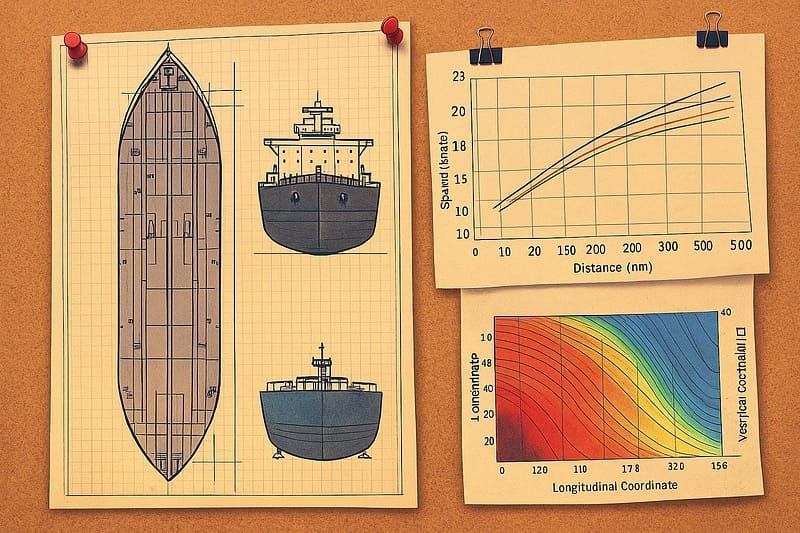
At this stage, naval architects take every assumption from the concept phase and test it rigorously:
resistance, propulsion, stability, strength, weight, cost.
It’s like a stress test for ideas.
Because on paper, any ship can float — but in the real world, the ocean has its own opinions.
When I studied this part of the process, I realized that ship design isn’t just creative work — it’s an ongoing experiment in realism.
Numbers don’t just describe the vessel; they decide its survival.
Simulating the Sea
The first big task is to quantify performance.
Everything the owner expects — speed, range, fuel economy — is verified through analysis and simulation.
- Resistance & Propulsion Tests — using CFD or towing-tank models to predict drag and required power.
- Stability Analysis — verifying that the vessel remains upright through all loading conditions.
- Seakeeping Evaluation — predicting motions, roll, and comfort in waves.
- Powering Calculations — matching the engine, propeller, and hull for optimal efficiency.
It’s fascinating to watch how these models turn abstract geometry into measurable physics. And even more fascinating to see how a 1 percent error in resistance can ripple through the entire ship’s economics.
That’s when I understood: preliminary design is where mathematics becomes moral — every decimal place carries ethical weight, because it affects cost, safety, and trust.
Strength, Structure, and Weight
Once the ship’s hydrodynamic behavior is confirmed,
attention shifts to structural integrity and weight distribution.
- Midship Section Design — ensuring bending strength for waves and cargo loads.
- Finite Element Modeling — analyzing local stress in decks and bulkheads.
- Weight Estimation & Margin Control — predicting how every ton of steel affects draft, stability, and performance.
I was surprised by how much of ship design is really weight management.
Add a safety margin in one area and you might lose efficiency somewhere else. Remove too much and you risk structural failure. I had an impression that balancing those trade-offs is less about formulas and more about judgement — a kind of intuition that only experience, mistakes, and humility can teach.
Systems Integration and Early Schematics
During preliminary design, major systems also begin to take shape:
machinery spaces, propulsion lines, electrical distribution, HVAC, and safety systems.
This is when designers create System Block Diagrams and One-Line Schematics — simplified drawings that explain how power, data, and fluids will flow throughout the vessel.
It’s still too early for wiring diagrams or pipe details,
but just the right time to ask:
- How do we route cables through watertight bulkheads?
- Where will control networks and sensors be isolated for safety?
- How will redundancy be maintained in critical systems?
I remember thinking how every line on those schematics represents a real-world compromise between efficiency, safety, and maintainability.
Design, I realized, is really the art of planned imperfection.
Review and Approval — The First Gate of Reality
By the end of preliminary design, the shipyard may have produced a comprehensive package:
- Updated General Arrangement (GA)
- Hydrostatic and Hydrodynamic Reports
- Powering and Propulsion Summaries
- Preliminary Structural Plans
- Weight and Stability Books
This package is then reviewed by the owner and the classification society (Class). They verify that the design satisfies every rule and that the promised performance is technically achievable.
Only after this approval can the project move forward to the Basic Design stage, where systems and structures are detailed for production.
That review is more than paperwork — it’s a collective handshake between imagination and accountability.
Lessons from Studying Preliminary Design
What struck me most while studying this phase is how it redefines the word proof. Proof here isn’t a formula — it’s the ability to withstand scrutiny from physics, regulation, and people.
To design a ship preliminarily is to live in constant negotiation with reality.
You start with confidence, then discover uncertainty, and end with enough evidence to move forward.
Moving Toward Basic Design
Once preliminary design is approved, the ship is no longer an idea — it’s an authorized plan. Now begins the Basic (or Functional) Design stage,
where every compartment, cable, and conduit is defined, and the shipyard starts preparing for construction.
That’s what the next story will explore:
👉 “Basic Design — From Engineering Principles to Buildable Blueprints.”
✍️ Closing Thoughts
The Preliminary Design phase taught me that verification is the silent backbone of creativity. No dream survives the ocean unless it’s proven against its laws.
Tags:
#Shipbuilding #Maritime #Engineering #Design #Process #NavalArchitecture