
On this page
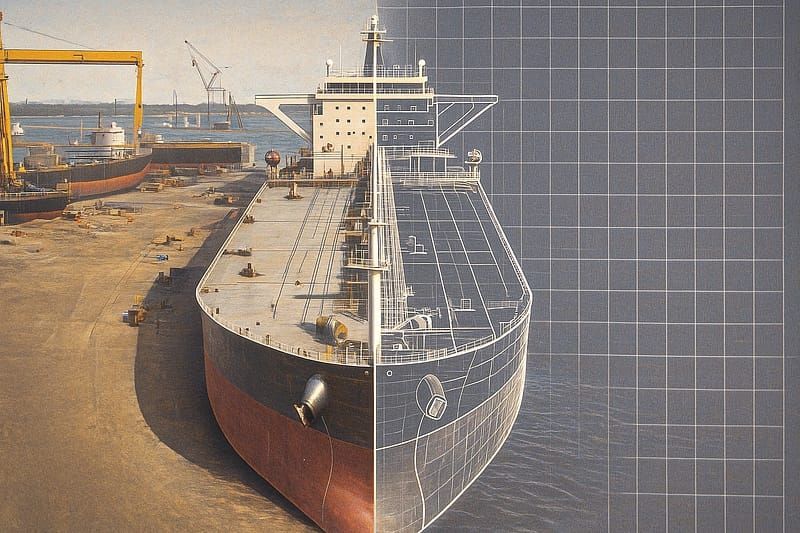
When engineering imagination meets physics, reality begins to take form.
By Tony Shin
If the Owner’s Requirements phase is about defining the DNA of a ship,
then Concept Design is where that DNA starts to grow bones and muscle.
This is the point where vision turns into geometry,
where a set of performance goals begin to take physical shape.
It’s also the stage that made me realize:
ship design isn’t a single act of creation — it’s an ongoing dialogue between imagination and physics.
From Vision to Feasibility
Every concept design starts with a question:
“Can this ship, as imagined by the owner, actually exist?”
As far as I learned, the job of the naval architect is to translate abstract intentions into achievable parameters(such as speed, weight, capacity, stability, and power, etc.)
Most of the time, the designing department or team balances 4 competing forces:
- Performance — speed, range, fuel consumption
- Structure — strength and weight
- Economy — construction cost and efficiency
- Regulation — compliance with international and class standards
The result is not yet a final design — it’s a feasible concept,
a ship that could exist in the real world if built according to these principles.
When I first studied this process, I expected calculations and software models. What I found instead was rather a deep, iterative form of reasoning — a conversation between creativity and constraint.
Lines, Forms, and Balance
The heart of concept design lies in shaping the hull — the outer geometry that defines everything else.
- Hull Form Development: balancing resistance, stability, and seakeeping.
- Lines Plan: curves that define the ship’s underwater shape.
- Hydrostatic Calculations: displacement, buoyancy, draft.
- Powering and Propulsion Estimates: how much energy it takes to move that shape through water.
- Other factors that I might have missed to list up here(Keep in mind that I am not the design expert)
It sounds purely mathematical, but it’s surprisingly artistic.
A subtle change in the hull curvature can alter resistance by a few percentage points — enough to make or break the efficiency targets set by the owner.
In modern shipyards, designers use simulation tools like CFD (Computational Fluid Dynamics) to visualize water flow, resistance, and pressure fields. But behind every elegant model lies the same timeless question:
“How can we make the sea cooperate — just a little bit more?”
Integrating Function and Form
Once the hull shape is roughly defined, attention shifts inward.
The designer must decide how to fit everything the ship needs into that limited space:
engines, tanks, cargo holds, living quarters, navigation systems, and safety equipment, etc.
This is where the General Arrangement (GA) drawing comes to life.
It’s the blueprint of blueprints —
a single document that tells you where every major system, space, and structure will go.
It must satisfy hundreds of rules simultaneously:
- Safety (SOLAS, class requirements, IMO regulations)
- Operational efficiency (engine access, cargo handling routes)
- Human factors (crew comfort, visibility, habitability)
- Maintenance access and redundancy
While studying GA layouts, I realized how impossibly delicate this balance is. Every compartment competes for space, and every decision reflects a trade-off between ideal and achievable.
The best ship designs, I learned, are not the ones that fit everything perfectly — but the ones that compromise wisely.
Numbers Behind the Beauty
Concept design is where math and aesthetics quietly merge.
You’ll see endless spreadsheets filled with ratios and coefficients:
block coefficient (Cb), prismatic coefficient (Cp), longitudinal center of buoyancy (LCB), and the famous Froude number — the fingerprint of hydrodynamic behavior. (I am still not familiar with these concepts, yet stated here to continue to write this blog)
Each value carries meaning and each adjustment echoes through the entire vessel. Move the center of gravity by half a meter, and stability changes.
Increase hull beam by one percent, and resistance jumps.
Studying this made me appreciate how ship design isn’t about drawing ships —
it’s about negotiating with the laws of physics. (How amazing is this!)
Concept Review — Where Imagination Meets Accountability
When the design stabilizes, the shipyard presents it to the owner and classification society. Together they review whether the proposed vessel meets:
- Performance goals (speed, range, fuel use, etc.)
- Safety margins and regulatory compliance
- Economic feasibility (cost, delivery schedule, other business and financial factors)
This review often loops several times — a rhythm of propose, test, revise, and justify. And in that loop, something interesting happens:
The designer’s imagination begins to solidify into consensus.
That’s the moment I felt such fascination with concept design.
It’s when ideas stop being “mine” or “yours” and become “ours.”
Lessons from Studying Concept Design
As I kept learning, one theme kept returning:
concept design is not just about shapes — it’s about thinking systems.
To understand a ship at this stage, you must think like:
- An engineer (for performance and power)
- An economist (for cost and efficiency)
- A regulator (for safety and compliance)
- And, sometimes, an artist (for balance and proportion)
Every decision touches another discipline.
Every drawing carries consequences downstream — into structure, outfitting, and operation.
And again, I found myself humbled.
The more I try studying ship design, the more I realize how little any single person can truly “know.”
Yet that’s what makes it beautiful — it’s collaborative knowledge, built line by line.
Moving Toward Preliminary Design
Once the concept design is accepted, the next stage begins: Preliminary Design. This is where performance is proven — not just imagined.
Here, calculations become evidence, and the vessel moves one step closer to being buildable.
That’s what I’ll explore next:
👉 “Preliminary Design — Proving That the Ship Can Actually Work.”
✍️ Closing Thoughts
The Concept Design phase reminded me that shipbuilding is not about copying templates — it’s about inventing balance each time.
Every vessel starts as an idea, shaped by ambition, constrained by physics,
and guided by people who dare to translate both.
The sea accepts only what’s real. And it’s in Concept Design that reality first begins to take shape.
Tags:
#Shipbuilding #MaritimeEngineering #DesignThinking #LearningInPublic #NavalArchitecture #EngineeringJourney