
On this page
Why the maritime industry should start addressing cyber-related operational risk before disruption becomes harder to manage
This is a timely discussion piece on why maritime cybersecurity risk in the Strait of Hormuz should be treated as an active operational issue — not just a technical or background concern.
A practical perspective on cyber-related operational resilience in a high-tension maritime chokepoint
Maritime Cybersecurity Risk in the Strait of Hormuz
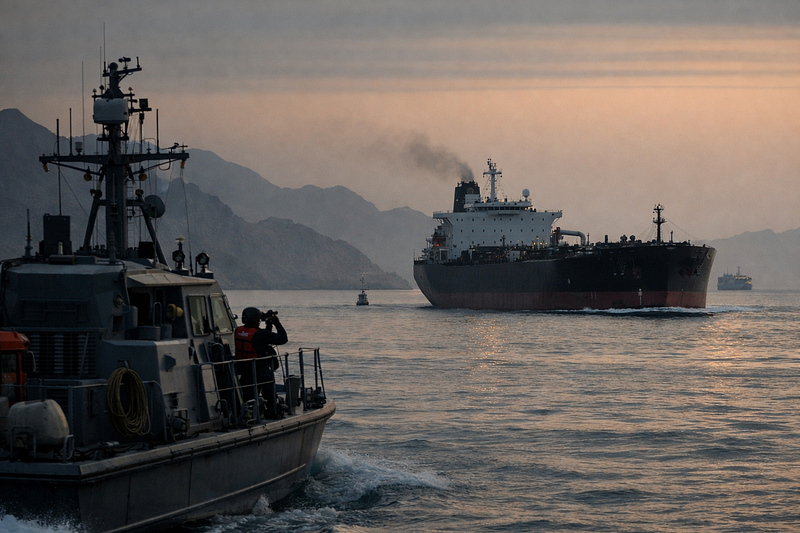
Why the maritime industry should start addressing cyber-related operational risk before disruption becomes harder to manage
I am sharing this perspective with some urgency because I believe this is a discussion the maritime industry should be having now.
This is not intended as a definitive assessment, nor as a formal intelligence product. It is a practical perspective on a fast-changing risk environment — one in which geopolitical instability, maritime chokepoint pressure, and cyber-related operational uncertainty can no longer be treated as separate issues.
The purpose of this article is simple: to raise the issue early, while there is still room for proactive thinking.
Why this matters now
The Strait of Hormuz has always been more than a geographic chokepoint. It is a corridor where commercial shipping, energy security, military signaling, and operational risk intersect in real time.
When tension rises in this region, the immediate discussion often focuses on physical security, transit disruption, naval escalation, or insurance exposure. Those are all valid concerns.
But there is another layer that deserves far more attention than it usually gets:
maritime cybersecurity risk under conditions of heightened operational pressure.
In other words, the issue is not only whether ships can continue moving. It is whether vessels, operators, and supporting stakeholders can continue making sound operational decisions when confidence in systems, signals, communications, and surrounding infrastructure begins to weaken.
That is where maritime cybersecurity becomes a live management issue.
The real risk is not only system failure
One of the most common mistakes in cyber risk discussions is assuming that danger begins only when a system fully fails.
In practice, operational risk often starts earlier.
It starts when crews and operators begin to lose confidence in whether the information they are relying on is still trustworthy enough to support safe judgment.
A navigation system may still display data. Communications channels may still appear available. Traffic information may still be partially visible. Core systems may still technically function.
And yet, the situation can still become materially more dangerous if trust in those systems begins to erode.
That distinction matters because maritime operations depend not only on equipment availability, but on confidence in the reliability of the operating picture.
Once trust weakens, the burden shifts rapidly from technology to human interpretation, fallback procedures, and decision-making under pressure.
Why the Strait of Hormuz creates a special cyber risk environment
In a high-tension chokepoint environment, cyber risk should not be understood only as a classic “hack” or a narrow IT incident.
It is better understood as a broader resilience problem that can affect:
- confidence in navigation inputs,
- confidence in situational awareness,
- confidence in communications,
- and confidence in the continuity of surrounding maritime and port-side operations.
That is what makes the Strait of Hormuz especially important from a cybersecurity perspective.
Even if no single catastrophic cyber event is visible, the operating environment itself can become more fragile when the cost of confusion rises and the tolerance for ambiguity falls.
In these conditions, cyber-related risk is not limited to malware or direct system compromise. It can also emerge through degraded trust, conflicting signals, disrupted assumptions, and the increased likelihood of poor decisions made under uncertainty.
Four practical cyber-related questions the industry should be asking
1) Can bridge and fleet teams operate safely if trusted signals become less trustworthy?
Modern maritime operations depend heavily on digital signals, integrated systems, and connected information flows.
The critical question is not only whether those systems remain online. The more important question is whether crews can still trust them enough to make safe and timely decisions.
If signal confidence weakens — even without total failure — the operational burden can rise quickly.
This is where fallback readiness becomes essential.
2) Are operators too dependent on normal visibility assumptions?
Commercial shipping works best when situational awareness tools, tracking assumptions, and standard operating patterns remain stable.
But chokepoint stress can weaken those assumptions very quickly.
When the traffic picture becomes less reliable, partial visibility can create false confidence. Operators may still feel they have enough information to proceed normally, even when the risk environment has already changed.
That is not only a navigation issue. It is a cyber-enabled operational risk issue.
3) Are communications protocols resilient under ambiguity?
In normal circumstances, standard communications procedures are familiar and efficient.
In a stressed environment, however, communications can become slower to interpret, harder to validate, and more vulnerable to confusion, pressure, or misjudgment.
This means resilience is not only about network security architecture or onboard technology.
It is also about whether bridge teams, shore teams, and operators can distinguish between routine instruction, uncertainty, and escalation pressure without losing decision quality.
4) Are vessel operators thinking broadly enough about ecosystem exposure?
Maritime cyber resilience is not just a shipboard issue.
Even where a vessel’s own systems remain functional, disruptions across the wider logistics chain — terminals, ports, industrial systems, scheduling interfaces, service providers, and connected partners — can still produce serious commercial and operational consequences.
That is why maritime cybersecurity in a chokepoint environment must be viewed as an ecosystem issue, not only a vessel issue.
What shipowners and maritime leaders should do now
The right response is not panic.
It is not to assume every disruption signal automatically means a confirmed cyber event.
And it is not to wait for perfect clarity before treating the issue seriously.
The more useful response is to ask practical questions now:
- Are cyber-related contingency procedures usable in real operations, not just on paper?
- Are crews prepared for degraded-confidence conditions, not only complete equipment loss?
- Are bridge and shore-side escalation protocols clear enough under pressure?
- Are dependencies on third-party systems, terminals, and external communications sufficiently understood?
- Do current internal discussions still treat cyber, operational disruption, and geopolitical instability as separate categories when they may now overlap in practice?
These are leadership questions as much as technical ones.
Why raise this before the picture is complete?
Because resilience discussions are often most valuable before the situation becomes fully visible.
In a developing risk environment, some assessments will inevitably need refinement. Some concerns may later prove overstated. Some scenarios may never materialize in the way initially feared.
That does not make early discussion unnecessary.
If anything, it makes early discussion more important.
The maritime industry is at its strongest when it acts before operational stress turns into forced reaction.
That is the spirit of this article.
Not to claim certainty.
Not to overstate the threat.
But to make the case that maritime cybersecurity risk in the Strait of Hormuz should be treated as an active operational concern now — while there is still time to prepare thoughtfully rather than respond defensively.
Final thought
The maritime sector has become deeply dependent on trusted digital systems, connected operations, and stable assumptions about how information moves between ship, shore, and the wider logistics environment.
That has created efficiency.
It has also created new forms of vulnerability.
In a place like the Strait of Hormuz, the first thing to deteriorate may not always be physical access.
Sometimes, it is confidence.
And once confidence begins to erode, cyber-related operational risk rises much faster than many organizations expect.
That is why this conversation should begin now.
This article is intended as a discussion-oriented perspective on maritime cybersecurity risk in a high-tension operating environment. It is not a formal intelligence assessment, legal opinion, insurance advisory, or military guidance. Its purpose is to encourage timely and practical industry discussion while the situation is still developing.