
On this page
Introduction
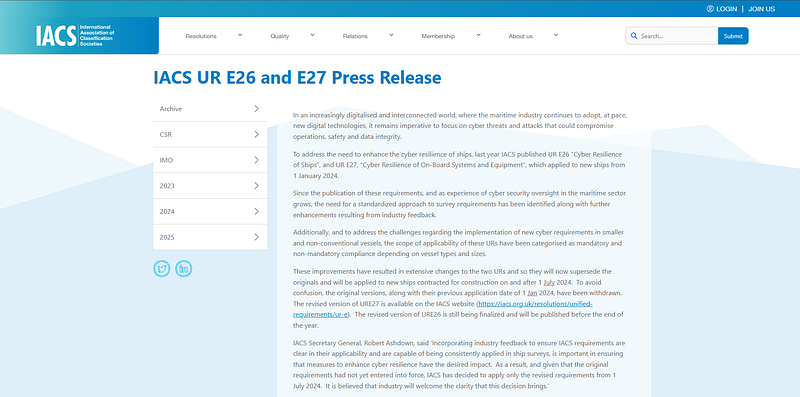
IACS Unified Requirement E26 “Cyber Resilience of Ships” represents the most comprehensive mandatory cybersecurity standard in maritime history, fundamentally transforming how vessels are designed, built, and operated. Effective July 1, 2024 for all new ships contracted for construction, this standard addresses critical vulnerabilities in ship operational technology systems that could compromise safety, environmental protection, and global supply chains. The regulation emerges from a decade-long recognition that maritime digitalization created unprecedented cyber risks, culminating in a framework that will reshape the industry through 2050.
From voluntary guidance to mandatory transformation
The development of UR E26 reflects the maritime industry’s evolution from reactive incident response to proactive cyber risk management. The standard’s origins trace to 2017’s IMO Resolution MSC.428(98), which established cyber risk management as mandatory for Safety Management Systems following mounting evidence of maritime vulnerabilities. High-profile incidents, particularly the NotPetya malware attack that cost Maersk $300 million in 2017, demonstrated how cyber threats could cripple global shipping operations.
IACS initially developed twelve separate cybersecurity recommendations between 2017–2020, eventually consolidating them into Recommendation 166 before creating the mandatory UR E26 and companion UR E27 standards in April 2022. The standards underwent significant revision in November 2023 based on industry feedback, with implementation moved from January to July 1, 2024 to ensure consistent application across the industry.
The regulatory framework addresses a 900% increase in operational technology cybersecurity breaches and recognizes that modern ships can no longer rely on traditional “air-gapped” system isolation. As ships became increasingly connected to shore-based systems and integrated critical navigation, propulsion, and cargo handling systems, they created new attack vectors that could directly impact vessel safety and operations.
Comprehensive technical framework covering entire vessel lifecycle
UR E26 establishes a five-functional-element cybersecurity framework based on the NIST Cybersecurity Framework: Identify, Protect, Detect, Respond, and Recover. This goal-based approach applies to operational technology (OT) systems that control physical processes critical to vessel safety, including propulsion, steering, navigation, fire detection, and cargo handling systems.
The standard requires security zones and conduits architecture inspired by IEC 62443 industrial cybersecurity standards, creating digital “watertight compartments” that isolate critical systems. Navigation and communication systems cannot share zones with machinery or cargo systems, while wireless devices must operate in dedicated security zones with manual isolation capabilities.
Key technical requirements include comprehensive inventory management with detailed network topology documentation, malware protection on all in-scope systems, multi-factor authentication for remote access, and continuous network monitoring with intrusion detection capabilities. The standard mandates incident response plans with clear breakpoints for system isolation and recovery procedures with defined Recovery Time Objectives (RTO) and Recovery Point Objectives (RPO).
Testing and certification requirements span the entire vessel lifecycle from design through operations. During construction, suppliers must provide integrated test plans with functional and failure scenario testing. The commissioning phase requires updated test plans aligned with final configurations, while operational phases demand continuous compliance maintenance with periodic testing and documentation updates.
Implementation challenges creating industry-wide transformation pressure
Current implementation reveals significant practical challenges that are reshaping maritime industry dynamics. Supplier readiness represents a critical bottleneck, with only limited systems receiving type approval under companion standard UR E27. As of late 2024, ClassNK had approved only four systems while DNV approved approximately twenty, creating substantial compliance challenges for shipbuilders and owners.
The documentation burden far exceeds traditional classification requirements, with vessels potentially requiring thousands of cybersecurity-related documents transferred from shipyard to owner. Industry experts describe compliance requiring “hundreds of hours of consultancy work” with ongoing monthly service costs rather than one-time expenses. This creates recurring operational expenses that particularly impact smaller operators.
System integration complexity poses perhaps the greatest challenge, as increasingly interconnected systems create hidden vulnerabilities that become apparent only during penetration testing. Energy monitoring systems, commonly installed for fuel efficiency, frequently create unexpected security exposures by connecting to multiple critical OT systems without proper isolation.
Operational phase implementation faces unique maritime constraints, including change management difficulties during port maintenance windows and limited crew resources for simultaneous manual system operation during cyber incidents. The industry’s traditional culture of operational secrecy regarding cyber incidents contrasts sharply with aviation’s open reporting systems, hampering collective learning and best practice development.
Cost implications driving strategic fleet decisions
Financial implications extend far beyond basic compliance costs, creating strategic decision points for shipowners. Direct costs include substantial consultancy fees, recurring service expenses, and increased IT budgets, while indirect costs encompass dual system management for mixed fleets and supply chain premiums for type-approved equipment.
The US Coast Guard’s parallel maritime cybersecurity rule provides cost benchmarks, estimating $1.2 billion total implementation costs with $138.7 million annualized expenses across the US fleet. These figures contrast with average maritime cyberattack costs exceeding $550,000 per incident, not including reputational damage and operational disruption.
Industry experts anticipate that owners will progressively apply UR E26 standards to existing fleets for risk mitigation, even where not mandatory. This creates competitive pressure as charterers increasingly demand UR E26 compliance proof during negotiations, while insurers may adjust coverage terms based on cybersecurity capabilities.
Future vessel design embracing “secure by design” philosophy
UR E26 fundamentally transforms naval architecture by mandating cybersecurity integration from earliest design phases rather than retrofitting security measures. This represents a paradigm shift toward “secure by design” philosophy that treats vessels as integrated cyber-physical systems requiring holistic security approaches.
Future vessel designs must incorporate network segmentation architecture based on zones and conduits methodology, creating unprecedented collaboration requirements between naval architects, system integrators, and cybersecurity specialists. The standard’s lifecycle-integrated security approach creates new project management practices extending from design through construction, commissioning, and operational life.
Shipyards mastering UR E26 implementation gain significant competitive advantages, offering owners vessels that are “ready for the digital future” while enabling secure implementation of autonomous operations, predictive maintenance, and advanced energy management systems. This positions cyber-resilient vessels as premium assets in an increasingly digital maritime environment.
Technology development acceleration toward autonomous and sustainable shipping
The standard serves as a critical enabler for maritime digitalization initiatives, including artificial intelligence implementation for threat detection, blockchain technology for secure communications, and Internet of Things security as maritime IoT deployments approach 30.9 billion units by 2025.
UR E26’s integration with decarbonization efforts enables secure implementation of alternative fuel systems, energy efficiency monitoring, and shore power integration. Enhanced cybersecurity capabilities support development of autonomous vessels that contribute to decarbonization through optimized operations and route planning.
The standard anticipates future regulatory developments including data protection requirements, artificial intelligence governance frameworks, and supply chain security regulations. Organizations treating UR E26 as merely regulatory compliance risk missing its transformative potential for positioning leadership in the industry’s digital and sustainable transformation.
Industry perspectives revealing security-compliance tension
Current industry perspectives reveal mixed reactions balancing support for standardization with concerns about practical effectiveness. Maritime cybersecurity experts warn that “compliance may not result in security,” noting that UR E27-approved systems only protect against “casual or coincidental access” while skilled attackers can still compromise compliant systems.
Classification societies generally support the standard’s comprehensive framework, with all major societies implementing aligned guidance despite variations in application methodology. Technology providers advocate for “more holistic approaches to onboard cybersecurity” beyond basic compliance, while legal experts note that seaworthiness implications create potential liability for non-compliance.
The industry consensus recognizes UR E26 as a foundational element rather than final solution, with recommendations to use compliance as minimum standards while implementing additional security measures including vulnerability assessments and penetration testing beyond regulatory requirements.
Conclusion: Catalyzing maritime industry transformation
IACS UR E26 extends far beyond cybersecurity compliance to become a fundamental driver of maritime industry transformation through 2050. Its implementation catalyzes advances in vessel design, operational practices, technology development, and competitive dynamics that position the maritime industry for fully digital, sustainable, and autonomous operations.
The standard’s integration with broader trends including decarbonization, digitalization, and supply chain resilience establishes cybersecurity as an essential competitive capability rather than regulatory burden. Organizations embracing UR E26 as strategic opportunity can position themselves as leaders in the industry’s transformation toward cyber-secure, environmentally sustainable, and technologically advanced maritime transportation that supports resilient global supply chains in an increasingly digital world.